From Rails to AI- 5 Things PM Modi Addressed at “NaMo 4 Viksit Bharat”
PM Modi’s Vadodara speech 5 key takeaways on freight corridors, C-295 aircraft, new rail lines, solar power, and India’s AI skilling push.
.
You're reading Entrepreneur India, an international franchise of Entrepreneur Media.
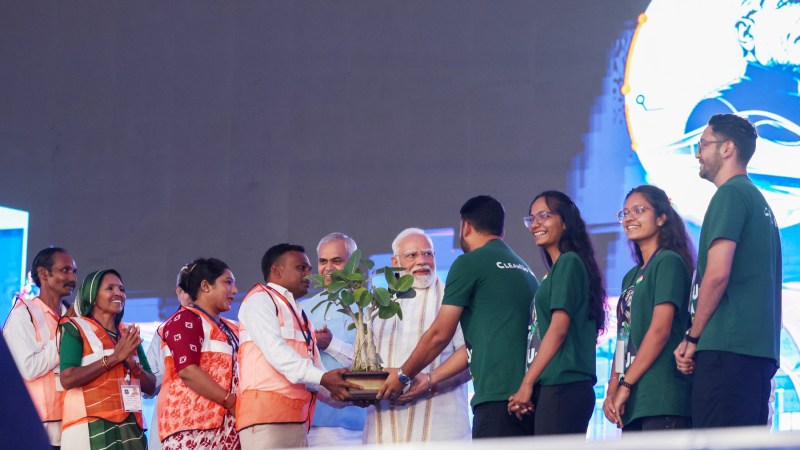
On 8 September, PM Modi arrived in Vadodara for what turned into a full-scale infrastructure showcase under the “NaMo 4 Viksit Bharat” banner unveiling and laying foundation stones for projects worth over INR 35,000 crore in a single day. The speech moved between four broad themes: National logistics infrastructure, Gujarat’s rise as a manufacturing and Defence hub, energy and Welfare schemes, and a forward-looking pitch on skills and technology for 2047. He also took a few sharp jabs at the previous UPA government’s track record while making his cas.
Here’s the 5 Key Takeaways.
1. The Freight Corridor Is Finally Complete — And It’s a Gamechanger
The headline moment: the completion of the 2,800 km Eastern and Western Dedicated Freight Corridors, with the separation of freight and passenger traffic enabling more than 430 freight trains to operate daily while cutting cargo travel time from around 30 hours by road to just 10-12 hours. To make the scale concrete, he cited a double-stack container train running from JNPT to Vadodara, carrying cargo equivalent to more than 250 trucks in one go. He also framed this as a farmer-friendly upgrade faster corridors mean fruits, vegetables and flowers can reach markets quicker.
2. Vadodara’s New Identity: “Made in India” Fighter-Transport Aircraft
Modi leaned hard into Vadodara’s defence-manufacturing story. He referred specifically to the C-295 military transport aircraft manufacturing programme in the city, saying Vadodara is now known for producing India’s first “Made in India” military transport aircraft. This builds on the Tata-Airbus facility that’s been operational since 2024 — now positioned as a symbol of the city’s shift from old-economy industries. In fact, he traced Vadodara’s journey from earlier textile and tile production to an industrial center known for oil and petrochemicals, and now a major hub for MSMEs.
3. Railways Get a Massive Local Boost
Beyond the freight corridor, three brand-new rail projects were announced for the region: third and fourth lines between Vadodara and Ratlam, gauge conversion of the Miyagam Karjan-Choranda-Malsar section, and doubling of the Vishwamitri-Dabhoi section, together covering 329 km and costing more than INR 9,700 crore. Modi used the moment to contrast past and present delivery speeds, saying: “Today, one new train after another is being introduced throughout the year.”
He also took a swipe at the previous UPA government’s pace of work, claiming it could not build 50,000 toilets in 10 years a jab set against his own government’s record of manufacturing nearly 50,000 modern railway coaches and adding almost 2.5 lakh wagons since 2014.
4. Solar Power for the Common Household
Shifting to energy, Modi highlighted the PM Surya Ghar Muft Bijli Yojana – India’s rooftop solar scheme. He said the programme had already benefited 55 lakh families nationwide, including 11 lakh households in Gujarat alone, tying it to his larger push on domestic solar manufacturing.
5. Free Coaching, AI Skilling, and the 2047 Vision
This is where the speech turned future facing. Modi announced free coaching for competitive exams to ease the financial load on poor and middle-class students and said the government would prioritize building AI skills among the youth, with applications spanning agriculture, healthcare, robotics, and manufacturing. He tied this to the need for stronger electricity supply and secure access to critical minerals and rare earths the raw materials any AI-driven economy will need all positioned as building blocks toward a Viksit Bharat (developed India) by 2047.
On 8 September, PM Modi arrived in Vadodara for what turned into a full-scale infrastructure showcase under the “NaMo 4 Viksit Bharat” banner unveiling and laying foundation stones for projects worth over INR 35,000 crore in a single day. The speech moved between four broad themes: National logistics infrastructure, Gujarat’s rise as a manufacturing and Defence hub, energy and Welfare schemes, and a forward-looking pitch on skills and technology for 2047. He also took a few sharp jabs at the previous UPA government’s track record while making his cas.
Here’s the 5 Key Takeaways.
1. The Freight Corridor Is Finally Complete — And It’s a Gamechanger
The headline moment: the completion of the 2,800 km Eastern and Western Dedicated Freight Corridors, with the separation of freight and passenger traffic enabling more than 430 freight trains to operate daily while cutting cargo travel time from around 30 hours by road to just 10-12 hours. To make the scale concrete, he cited a double-stack container train running from JNPT to Vadodara, carrying cargo equivalent to more than 250 trucks in one go. He also framed this as a farmer-friendly upgrade faster corridors mean fruits, vegetables and flowers can reach markets quicker.
2. Vadodara’s New Identity: “Made in India” Fighter-Transport Aircraft
Modi leaned hard into Vadodara’s defence-manufacturing story. He referred specifically to the C-295 military transport aircraft manufacturing programme in the city, saying Vadodara is now known for producing India’s first “Made in India” military transport aircraft. This builds on the Tata-Airbus facility that’s been operational since 2024 — now positioned as a symbol of the city’s shift from old-economy industries. In fact, he traced Vadodara’s journey from earlier textile and tile production to an industrial center known for oil and petrochemicals, and now a major hub for MSMEs.

Entrepreneur Staff • Editor
Entrepreneur Staff
For more than 30 years, Entrepreneur has set the course for success for millions of... Read more