Rise of Vibe Coding & Seismic Reset of the Software Industry
Emergence of vibe coding as a solid segment can be validated by SpaceX’s landmark USD 60 billion acquisition of Anysphere, the parent company of AI code editor Cursor.
Pixabay
Opinions expressed by Entrepreneur contributors are their own.
You're reading Entrepreneur India, an international franchise of Entrepreneur Media.
A seismic architectural reset is happening in the software industry. At the epicentre is “vibe coding”, which is essentially natural language prompts replacing the laborious line-by-line syntax, and accelerating the idea to a functional product phase to an unprecedented speed. Vibe coding may have begun as sheer experimental novelty but is now being widely deployed by large and small enterprises, and interestingly, is finding a lot of adopters among founders without technical backgrounds.
USD 60 Billion Validation
Emergence of vibe coding as a solid segment can be validated by SpaceX’s landmark USD 60 billion acquisition of Anysphere, the parent company of AI code editor Cursor. The deal underscores the seismic architectural reset mentioned above.
“In the years since we started Cursor, better models have steadily expanded what people can build. Cursor has gone from completing the next few lines of code to building AI teammates that you can give real work to. Together with SpaceX, we will push that ambition further. We will have access to the largest fleet of GPUs in the world, giving us the compute to build stronger models that are also more economical to run,” Cursor said in a blog post.
Apart from the acquisition, a new wave of startups, some of which are highly VC funded, have emerged.
From India perspective, Emergent earlier this year raised USD 130 million in a Series C funding round led by Creaegis, with participation from Claypond, Sentinel Global, Khosla Ventures, SoftBank Vision Fund 2, Lightspeed and Y Combinator.
Here are some of the top AI coding companies:
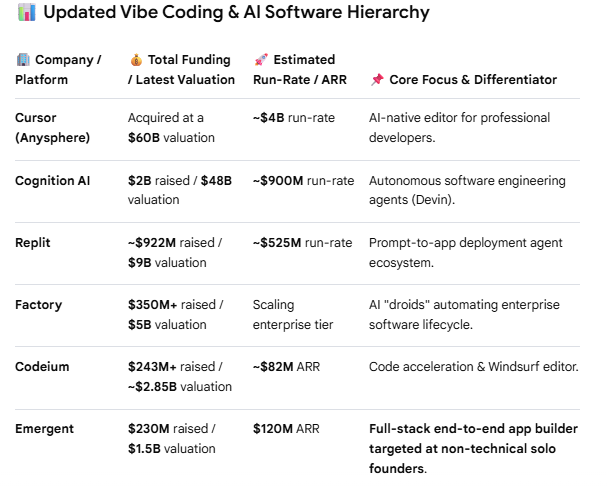
The nascent ecosystem shows that AI-driven development setups are going to stay, and will become integral part of the product development across the industry.
Also, it has more or less begun to democratise coding for every tier. As mentioned above, a lot of non-technical founders are now getting hands on with barebone software without having to bank on conventional engineering setup, allowing them to visualise their ideas at a much faster pace.
Parminder Singh, Co-founder at Redscope.AI, points out: “Vibe coding is collapsing the cost and time required to turn an idea into software, but it is not collapsing the complexity of building a product. As per Google’s 2025 DORA research found that ‘over 80% of developers report productivity gains from AI, while Stack Overflow’s 2025 survey shows a critical trust gap: 46% of developers distrust AI output, versus 33% who trust it.’ That tells us where the real shift is happening. AI is taking over more of the implementation layer, so the developer’s value is moving upstream from writing code to defining architecture, product behaviour, constraints and guardrails.”
Opportunity for India
India has been the back office for the globe for the longest time. And now it is itself becoming a massive market with millions of startups and hundreds of unicorns and semicorns. Vibe coding could be another booster for the Indian startup ecosystem which otherwise may have banked on venture capital to set up a barebone engineering setup to validate their concept. Vibe Coding kind of dissolves this compulsion.
Ashok Kadsur, Co-Founder of Melento (formerly SignDesk), explains how this has been a massive shift for Indian founders: “Vibe coding has not merely reduced the cost of building software; it has changed what founders should consider ‘capital’ in the first place. Earlier, a founder needed money to buy engineering capacity before learning whether the idea deserved engineering capacity. Today, AI can compress that learning loop from months to days. For early-stage products, I have seen the first usable version move from a significant engineering commitment to something that can be prototyped for a fraction of the cost. But the bigger advantage is not cheaper code. It is cheaper ignorance. Founders can discover what customers actually want before spending heavily on building it.”
Speed vs Results
Vibe coding works. But does it deliver a production-ready product? Experts are divided on the end product, especially for the larger enterprises with complex workflows, and that the technology (read AI) will eventually get there at some point. Presently, there are mixed opinions about prototype builds versus real-world tests which include curveballs like compliance and most importantly no scope for things like hallucinations or error.
Ranga Rao, Chief AI Architect at [x]Cube Labs, highlights the structural challenges that codebases could encounter: “Founders with no engineering background are already shipping working products in days instead of months, using AI to write most of the first version. The upfront capital needed to test a concept has dropped just as sharply. The catch is that ‘working’ and ‘production-ready’ are different claims. Most vibe-coded builds hold up fine for a demo or an early user test, then strain the moment real traffic, edge cases, or compliance requirements show up. Agencies are already adjusting: billable-hour pricing is losing ground to fixed-scope, speed-priced product builds.”
“The architectural wall tends to show up at the same point every time. Once a codebase crosses roughly a dozen interdependent features, AI models start duplicating logic instead of reusing it, because they lack persistent architectural memory across prompts. Left unmanaged, that produces exactly the unmaintainable sprawl developers worry about. Preventing it takes the same discipline any engineering team uses: enforced modularity, code review, and a human owning system design even when AI is writing most of the syntax,” he continued.
One of the ways, according to experts, to address these challenges is ensure guardrails are embedded directly at the development frameworks.
Kadsur elaborates on how Melento is dealing with the shift: “The question ‘Is vibe-coded software production-ready?’ is slightly misleading. Software has never been production-ready simply because a developer wrote it. At Melento, we have embedded vibe coding within our Melento Development Lifecycle (MDLC), where AI helps write and review code, generate tests, document features and accelerate releases—with guardrails around security and governance. That distinction matters. We don’t want AI replacing engineering judgement; we want it making engineering judgement faster and better informed. The real divide is no longer AI-written versus human-written code. It is engineered versus unengineered software. Vibe coding creates velocity. MDLC makes that velocity responsible.”
“The biggest mistake is asking AI to ‘write better code.’ AI optimises for the task in front of it; architecture optimises for everything that happens later. At Melento, MDLC addresses this by making AI part of a lifecycle rather than a code-generation shortcut. AI doesn’t just write code; it reviews it, generates tests and documents what has been built. We still define architectural boundaries, reusable components and dependency rules upfront. I think of MDLC as giving AI a constitution rather than just instructions. Without constraints, AI becomes an extraordinarily productive builder with no institutional memory. With them, it becomes the colleague who never forgets to review yesterday’s work.”
Singh also echoes this sentiment as he says: “Having spent years building products at Flipkart and scaling Scaler, I see this less as the ‘death of developers’ and more as the rise of the product engineer: someone who can translate an ambiguous user problem into a robust system and then use AI to build it faster.
The danger is that vibe-coded software can create the illusion of completeness. An MVP can work beautifully until it encounters scale, concurrency, security vulnerabilities, edge cases or a codebase that nobody understands six months later. That is where engineering judgement becomes the differentiator.”
True Defensible Moat
AI is making coding much easier but ease of access means it becomes much easier to replicate or clone the entire interface or feature set in a jiffy. For the longest time, several top consumer facing platforms have used software codes as one of the functions as a defensible moat. Does this go away with vibe coding?
Deepak Dhanak, Co-Founder & COO of Rocket, addresses this: “For twenty years SaaS companies treated the software itself as the asset or the moat. That’s over. If a competitor or a customer can prompt a working copy of your product in a weekend, features are no longer something you can charge a premium for, or it was not and will not be your defensible moat.
What’s left is harder to build and harder to copy. Data that only you have, and that gets better the longer customers use you. Being embedded in a customer’s daily operations so deeply that replacing you means retraining a team and rewiring processes. Replacing your tool/platform should result into loss of synergy. Compliance, security and reliability that took years to earn. And distribution: an existing base of customers who already pay you and trust you.
Most SaaS companies were never really selling code. They were selling the confidence that the thing works, that someone answers when it breaks, and that it will still be there in five years.
AI makes the code cheap. It doesn’t make any of the above cheap. The companies that get squeezed or will feel defenseless will be the ones whose only real asset was a feature set.”
Experts are more or less on the same page on this as value moves from syntax to things like execution and trust.
Rao adds: “And once anyone can prompt a clone of a product in a weekend, the defensible moat shifts away from the code itself and toward the data, workflows, and trust a company has built around it.”
Singh chips in saying: “For founders, this means the barrier to experimentation is falling dramatically—but the bar for building a defensible company is rising. When anyone can generate a functional product over a weekend, code itself becomes a weaker moat. The real moat moves to proprietary data, customer insight, distribution, product intuition and the feedback loops that continuously improve the product.
Vibe coding is democratising software creation. It is not democratising product judgement. The next generation of winners will be those who combine AI-speed with engineering depth and product intuition.”
Kadsur explains what could be the ultimate competitive edge for companies in the vibe coding era: “When software becomes cheap to reproduce, software itself stops being the moat. The moat moves into proprietary data, customer relationships, distribution, workflow integration and institutional knowledge. But there is another emerging advantage: your organisation’s ability to build and learn faster than competitors. That’s part of why we’ve embedded MDLC at Melento. We want AI to become every builder’s smartest teammate—not to replace the people building the product, but to make the entire learning-and-building loop faster. A competitor can clone your interface over a weekend. They cannot clone your accumulated customer trust, organisational learning or the speed at which your people turn that learning into the next product.”
A seismic architectural reset is happening in the software industry. At the epicentre is “vibe coding”, which is essentially natural language prompts replacing the laborious line-by-line syntax, and accelerating the idea to a functional product phase to an unprecedented speed. Vibe coding may have begun as sheer experimental novelty but is now being widely deployed by large and small enterprises, and interestingly, is finding a lot of adopters among founders without technical backgrounds.
USD 60 Billion Validation
Emergence of vibe coding as a solid segment can be validated by SpaceX’s landmark USD 60 billion acquisition of Anysphere, the parent company of AI code editor Cursor. The deal underscores the seismic architectural reset mentioned above.