Why Festive Sale Slump Signals Trouble For Smartphone Players
As newer-generation smartphones become more expensive, brands are increasingly leveraging previous-generation models to offer better value and sustain demand.
Pixabay
Opinions expressed by Entrepreneur contributors are their own.
You're reading Entrepreneur India, an international franchise of Entrepreneur Media.
The honeymoon period for smartphone companies, which relied on steep demand during the festive season, is finally over.
Indian smartphone sales during the 2026 festive season (October 8 to November 10) declined by an estimated 22% YoY, according to Counterpoint Research’s preliminary post-festive checks. The decline even beats the pre-festive forecast of 12%.
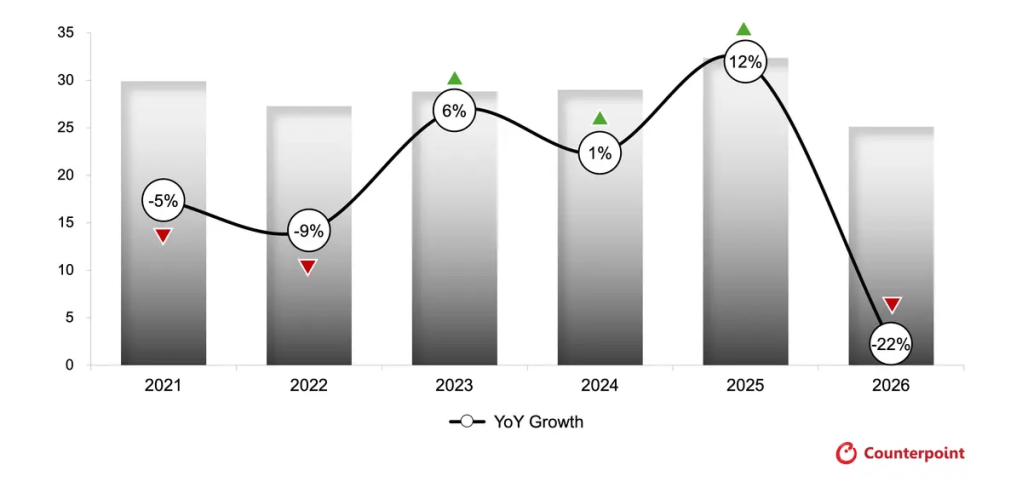
Smartphone sales did decline during the pandemic years but bounced back in the following years as the stay-at-home eased. Typically, smartphones have remained a hot category across platforms during the festive season.
For instance, India’s smartphone market had hit a five-year high in the festive third quarter of 2025 (3Q25), with 4.3% year-over-year (YoY) to 48 million units, according to an IDC report published last year.
Counterpoint’s December 2025 report says that smartphone sales reached 32.4 million units, registering an 11.5% YoY growth (highest since the 2020 festive period).
It’s worth pointing out that even as market volume declined by 22% during the 2026 festive season, value-wise the market stayed broadly flat YoY. This is likely due to the stronger demand for premium handsets which offset the losses in the remaining segments.
Expensive Chips
One of the key drivers for steep demand during the festive season has been the heavy discounts. This year around, however, discounts have narrowed to just 10% to 25%, from 35% to 40%, the Counterpoint report adds.
Shrinking discounts are primarily because DRAM and NAND prices have continued to go up as chip companies are allocating resources towards AI-led demand. It was inevitable that the consumer electronics industry would pass on the cost to consumers.
ALSO READ: Rising Memory Chip Prices & What It Means
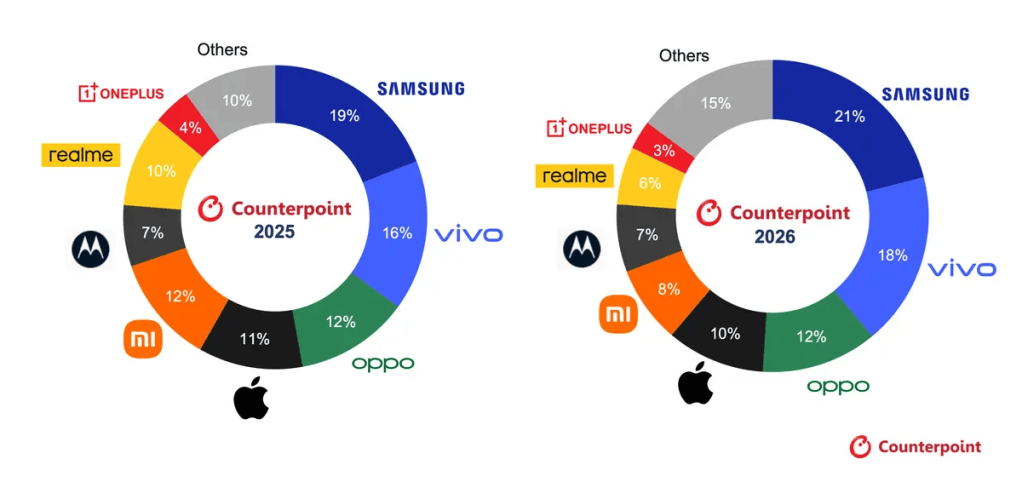
While Apple launched their new handsets at relatively higher prices, Android players like Samsung and Xiaomi raised prices of their models earlier this month.
Samsung reportedly raised prices of its at least 22 models by up to over 9% whereas Xiaomi raised by up to 19%.
“Even discounted entry-level models were generally priced higher than a year ago, putting upgrades out of reach for many price-sensitive buyers. Brands instead leaned on no-cost EMIs, bank offers and trade-ins, with 48% of smartphone sales being finance-led,” the report says.
The lull was seen across online and offline.
The report highlights that “online sales, which account for a significant share of smartphone purchases, declined as higher consumer traffic failed to translate into actual conversions. Mainline retail was initially slow, and consumers held back purchases in anticipation of better festive offers, with footfalls recovering during Navratri but conversions remaining weak.”
Over Budget
The budget segment which is typically priced between INR 10,000 to INR 20,000 was hit the hardest. According to Counterpoint, a sharp 50% decline was recorded in this segment. Though, emerging brands like Ai+, Mivi, and Boltt performed better than expected.
Research Analyst at Counterpoint Research, Shubham Singh, tells Entrepreneur India that the entry-level segment is facing greater pressure from rising component costs, and this is likely to continue as brands have limited room to absorb price increases in an already low-margin category.
A probable outcome will be that brands will become more selective with launches and adjust specifications to control costs.
“We expect the segment to see another double-digit decline in 2027 as rising prices continue to impact affordability,” Singh adds.
With the market situation which is chip companies splurging on AI, things are likely to remain difficult for smartphone companies. Historically, the festive period has consistently delivered a surge in demand to smartphone players.
“We expect smartphone demand to remain weak in the near term, as festive sales have not translated into a broader market recovery. Apart from higher prices and lower discounts, longer replacement cycles, cautious spending and weaker upgrade demand are also affecting sales. Consumers are holding on to their existing devices for longer, making financing, exchange offers and attractive deals increasingly important in driving purchases,” Singh adds.
Spotlight on Refurbished Segment
With newer handsets becoming more expensive, refurbished space has come under the spotlight.
India’s refurbished smartphone volume grew 13 percent YoY in the first half of 2026, according to a recent Counterpoint Research report. The double digit growth comes at a time when new smartphone volumes in the country have declined by 11 percent YoY.
The report also noted that trade-in and exchange programs, akin to what consumers get on newer devices, are becoming important growth drivers. It further notes that the expansion of refurbishment is also supporting the circular economy by extending device lifecycles and maximizing the value of smartphones that are already in circulation.
Another growth drivers are the increasing number of players in the organised space for refurbished. Some names like Cashify have been in the industry for a while. The market potential also opens up a window for newer players.
Grest Co-founder and CEO Shrey Sardana notes that the second-hand electronics market has existed for decades, but much of it was informal, with limited visibility into device condition, battery health, previous ownership or after-sales support.
Organised recommerce is bringing structure to this market through standardised quality checks, transparent grading, warranties and accountable customer service.
“Our revenue is currently split roughly 50:50 between Tier I and Tier II/III markets, which is a strong indicator of how the category is evolving. We see demand across students, young professionals, creators, entrepreneurs and working consumers. The demand is also becoming broader than just iPhones. MacBooks and iPads are increasingly becoming important categories for us, particularly among customers who want access to the Apple ecosystem at a more attractive value point,” Sardana added.
ALSO READ: Refurbished Lease of Life for Electronics amid Chip Crisis and the Circular Economy
Singh tells Entrepreneur India that as newer-generation smartphones become more expensive, brands are increasingly leveraging previous-generation models to offer better value and sustain demand.
“We also expect the refurbished smartphone market to gain traction, segment projected to grow around 16% YoY in 2026 as affordability becomes a bigger consideration. During the festive period, refurbished iPhones gained traction, due growing consumer acceptance of pre-owned premium devices. This trend is likely to strengthen as consumers seek premium experiences at more accessible price points.”
The honeymoon period for smartphone companies, which relied on steep demand during the festive season, is finally over.
Indian smartphone sales during the 2026 festive season (October 8 to November 10) declined by an estimated 22% YoY, according to Counterpoint Research’s preliminary post-festive checks. The decline even beats the pre-festive forecast of 12%.
Smartphone sales did decline during the pandemic years but bounced back in the following years as the stay-at-home eased. Typically, smartphones have remained a hot category across platforms during the festive season.