How Goal-bound, Niche AI agents are Reshaping Indian Enterprise IT
SolarWinds is also deepening its focus on R&D and growth in smaller cities in India. Read on.

pixabay
Opinions expressed by Entrepreneur contributors are their own.
You're reading Entrepreneur India, an international franchise of Entrepreneur Media.
Niche-focused AIs with guardrails are becoming increasingly common, especially among large enterprises. The latest to join the bandwagon is SolarWinds.
The 27-year-old company, which provides IT management tools to hundreds of thousands of organizations globally, is betting big on its agentic AI platform, Avior.
Launched in October, SolarWinds’ standalone agentic AI system is said to be purpose built for mission-critical IT environments. Built on the company’s platform, the AI system aspires to help IT teams securely define goals, coordinate specialised agents, and track progress towards measurable across hybrid digital ecosystems.
“Avior is designed to take on first-line work, so teams can not only be more strategic, but also proactively address the needs of their growing digital estates. As a standalone application, it works across products and environments, diagnosing issues or actions from the perspective of an operator, and pursuing goals that span the estate with advanced root cause analysis,” according to the company.
Rohit Shukla, APJC Leader, SolarWinds, explains the vision and objective behind the company’s new AI system.
“If you look at AI, AI has always been in those two vectors—one assistive, two autonomous. Now if it is assistive in nature, it cannot do much; it can only give you a lot of GenAI, right? If it is autonomous, there is always that fear of it going out of control. So the way we designed AI is something we know as goal-oriented AI agents, where every AI agent has a harness, has a human in the loop, and it can only do one goal. If my goal is to reduce alert noise, I cannot go and make any network changes. My job is to just look at all the alerts and deduplicate them. So the way we are using agentic is having the security harness and assigning it a goal,” he told Entrepreneur India.
Shukla also noted that the customers’ trust has to be earned instead of making tall promises. He hypothesized that a customer might just start on a recommendation mode; he can escalate it to balanced which means the agent can take a few tasks on himself and recommend the others that require attention, or the third stage is where you have full trust on the agent and you can say, “Okay, autonomously do this for me.”
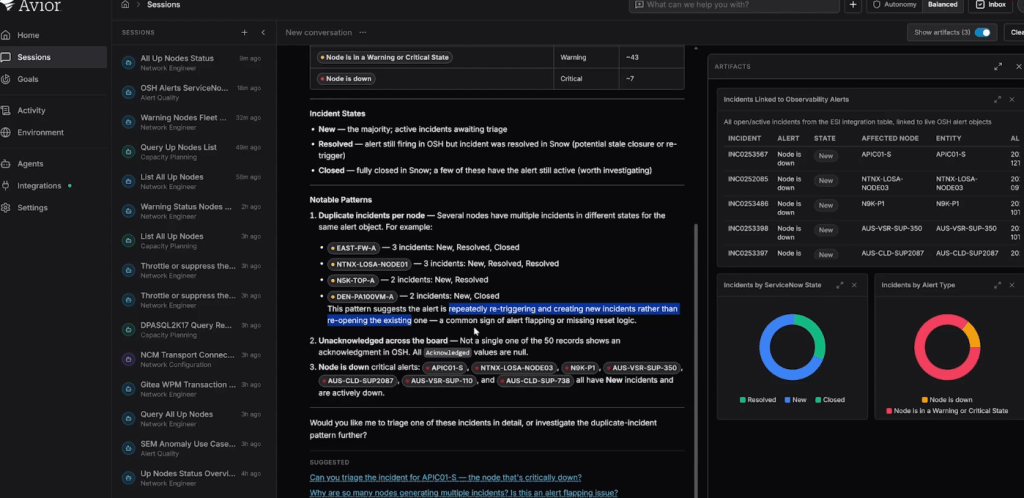
“But it can only do its goal; it cannot just go into the environment and change anything else. We are keeping it very sharp; we call it goal-oriented, and the flag or the umbrella is called Avior for SolarWinds, and within Avior we have an agent fleet. An agent fleet you can imagine as 25 different kinds of agents, every agent designed for a particular goal,” he continued.
Such an agentic AI system is the need of the hour as technology infrastructure is becoming increasingly complex. Though, it must perform on par with the conventional system as well as outdo to bring more efficiency for the IT teams.
As Shukla says, the AI has to be an enabler rather than a replacement.
A fine example is the recent Microsoft outage wherein millions of its users were unable to access different Microsoft services such as Outlook (email), Team messenger, and so after its Microsoft 365, company’s cloud-based subscription service that integrates core productivity software, collaboration tools, cloud storage, and security features.
According to Microsoft, the outage happened due to some issue in a configuration update leading to some servers becoming overloaded and eventually shutting down.
Interestingly, Microsoft chief Satya Nadella last year had said that 30% of Microsoft code is written by AI, and this number was increasing. The recent outage reflects the mismatch between output pace, and checks and audits.
Aligned with Global Trends
SolarWinds’ approach to the AI system is pretty much aligned with the global trend in the enterprise segment. To put things into perspective, typical or older versions of AI don’t really live up to the high-stake environments where a minor issue could cause severe outage.
The move also signals the company’s and an industry-wide shift towards tightly governed and goal-specific AI fleets. For instance, Dassault Systemes recently talked about a self-developed AI software engineer copilot called Leo.
“We built our own assistant, we call it Leo Software Engineer,” Sudarshan Mogasale, CEO of Dassault Systemes Solutions Lab had told Entrepreneur India. “Leo is our assistant which we sell to customers, but that version for a software engineer, we use inside the company to assist the development of software.”
Leo has already earned a reputation for its deep focus on standards, cybersecurity compliance, and verifies new code commits against legacy system architecture. This tool has altered developer workflows across Dassault’s Pune campus.
ALSO READ: Dassault Systemes Doubles Down on India with Industrial AI, Deeptech Focus
Like SolarWinds’ bet on Avior, companies like IBM are pushing watsonx Orchestrate, which is essentially an enterprise-grade AI agent management and workflow automation platform designed to build, deploy, orchestrate, manage, and govern AI agents across a business.
For IT leaders, IBM’s solution aims to reduce complexity, connect fragmented AI initiatives and give IT one place to orchestrate, govern and scale agents across the enterprise. It also helps apply consistent controls across a growing agentic portfolio, with better visibility into access, activity, policy and risk.
As mentioned above, the ongoing enterprise shift reflects a broader pivot towards goal oriented AI fleets. Considering the massive transition all around, IT managements may find such specialised AI systems handier in managing workflows, bring fragmented blocks under one umbrella, and ensure better oversight at scale.
Beyond Metro Cities
IT is generally synonymous with cities like Hyderabad, Bengaluru and other metro cities. These are the regions with the maximum number of tech startups and large conglomerates. Though, there’s a sizable opportunity beyond these metro cities. Moreover, with startups becoming cloud-native, the likes of SolarWinds now have a larger canvas.
“Essentially for SolarWinds, we don’t differentiate between customers having on-prem data centers, cloud-hosted instances, or both. We can manage and observe all sensors, whether it is on-prem, on cloud, or both. That is from a demand perspective. We are getting demand today from places like Jamshedpur, Calcutta, Jaipur, Jammu, Chandigarh… A lot of startups are in Gujarat and Maharashtra… So we consistently get that demand,” Shukla told
Entrepreneur India.
SolarWinds has different degrees of partners – Elite, Premier and Authorized.
“Essentially what we are doing is we are trying to get more and more Authorized partners on board across so that it increases our penetration to that Tier 2, Tier 3 segment, and then upskilling them to becoming a Premier or an Elite partner,” the executive added.
“As you can imagine, historically we had been a very Bangalore, Mumbai, Delhi business, and we are right now trying to decentralize it. Our biggest pockets right now are in the South, (Kerala, Chennai), and in the West(Nashik, Pune, Ahmedabad, Baroda, Surat belt). So that is the two ways we are going about demand: as to how we are catering to demand and how demand is coming to us.”
More on India
India is currently SolarWinds’ second-largest investment outside the US. Moreover, nearly 80% of its development-focused workforce operates from Bengaluru.
According to the company’s filings in Q4 2024, the company posted a 6% year-over-growth. Its total income in the said quarter stood at USD 72.7 million, and the adjusted EBITDA stood around USD 104.million, contributing to nearly 49% of the total revenue at a growth rate of 20%. For the full year 2024, the total revenue stood at USD 7796.9 million, a 5% increase from the previous year.
“We are looking at India as a huge talent market, a stable economy, and a place where it is safe to invest. Those are the three drivers where we are looking at India as a strategic investment destination rather than a revenue destination,” Shukla said.
“Looking at that market and the growth rate of that market, I mean, we should definitely be participating in that market and we should definitely be getting more customers to use us. Of course, the advantage that India customers have that a lot of other customers in other geos don’t have is, a lot of times when they have a deep technical query or a deep technical issue, the problem is right in the same time zone, in the same geography. A lot of our customers do understand that value, and the core techies definitely leverage our engineering teams based out of Bangalore, even though their job is not field-facing, but this is how it is working for us,” he continued.
That said, SolarWinds’ strategic push, a combination of goal-bound agentic AI and expansion of footprints across India, better equips the company to meet enterprise demands as enterprise IT infrastructures become more complex and intricate. Concept-wise, the move is set to lay a solid foundation for long-term growth and future innovation in an emerging market like India.
Niche-focused AIs with guardrails are becoming increasingly common, especially among large enterprises. The latest to join the bandwagon is SolarWinds.
The 27-year-old company, which provides IT management tools to hundreds of thousands of organizations globally, is betting big on its agentic AI platform, Avior.
Launched in October, SolarWinds’ standalone agentic AI system is said to be purpose built for mission-critical IT environments. Built on the company’s platform, the AI system aspires to help IT teams securely define goals, coordinate specialised agents, and track progress towards measurable across hybrid digital ecosystems.