Jio’s Big Test: The Market Prices a Digital Giant
Jio Platforms IPO was fully subscribed within hours of opening Wednesday, with institutional investors bidding over four times their quota.
Jio IPO
Opinions expressed by Entrepreneur contributors are their own.
You're reading Entrepreneur India, an international franchise of Entrepreneur Media.
Reliance’s Jio Platforms created history on Wednesday as its IPO was fully subscribed in less than 100 minutes of opening – considered to be one of the fastest ever subscribed offers among mega IPOs.
Jio Platforms, the digital arm of conglomerate Reliance Industries, is eyeing INR 30,213 crore with no Offer for Sale component and a price band of INR 1,065 – INR 1,119 per share. Considering the upper price band, the issue values the company at around INR 10.3 lakh crore (USD 108 billion).
The rush from institutions (via 2X subscription) and overall hype indicate the strong market confidence in Jio’s growth trajectory and long-term prospects.
The confidence, however, comes on the back of Jio’s continuous disruption in the market, which interestingly begins with its entry itself.
Turning back the time
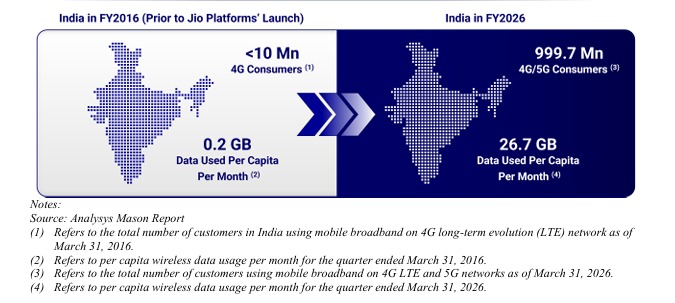
Nearly a decade ago, Reliance Jio disrupted the Indian telecom segment with low-cost data prices. Until that point, India’s mobile connectivity market was predominantly driven by high data prices and had over 10 operators. A majority of customers relied on 2G and 3G networks and smartphone penetration remained less than 30%.
While mobile and data were growing in India, Jio’s entry just catapulted the adoption, and forced rivals to compete with similar prices for 4G.
According to Jio’s RHP, the company achieved 100 million 4G customers in less than 180 days from commercial launch of service. By September 2017, Jio captured a market share of 42.67% of broadband customers in India.
Cut to 2026, the company serves 533.3 million customers (including 284.9 million 5G customers as of June 30, 2026), through its subsidiary Reliance Jio Infocomm Limited (RJIL), capturing nearly 60% of India’s wireless data traffic in FY 2026.
Ahead of the IPO launch, Jio Platforms Managing Director Akash Ambani said: “We’ve always believed that India has been a data scarce nation because it was supply constrained. Jio was the 14th operator to enter the market in 2016. We saw that as our biggest opportunity, to change India from a data scarce nation to a data abundant nation, and that’s what we’ve enabled 10 years from now. As the industry together today, we’ve grown from 14 players to just four.”
“Today we stand at 53 crore Indians who have trusted us as their digital connectivity partner. All of this in just the last 10 years,” he continued.
Beyond expanding digital access, Jio’s market disruption is credited for driving India’s digital economy, helping create an ecosystem where thousands of internet startups flourished.
Telco+
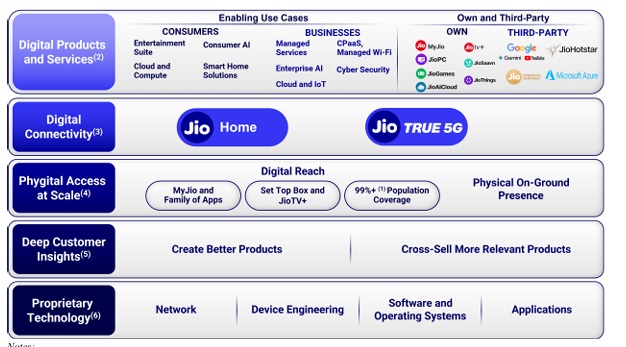
Jio is omnipresent across India. The company has well leveraged its massive scale to provide a wide range of services beyond basic connectivity, which include the following:
Entertainment: JioTV+, JioSaavn, JioGames, and JioHotstar
Cloud & Productivity: JioAICloud and JioPC
Smart Home & IoT: Jio Set-top-box, JioHome automation, and IOTs
AI & Software: JioBrain, cloud infrastructure and enterprise services.
Enterprise Solutions: Leased lines, MPLS VPN, managed Wi-Fi, private 5G, and industrial IoT (smart metering, fleet management)
Jio expects exponential growth in the above segments as India’s digital ecosystem continues to mature. The all-in-one approach essentially keeps the userbase engaged in its ecosystem.
This is what makes the IPO significant as investors are keen on not just on its size but also the nature of its business.
For an IPO of this size, success isn’t about squeezing out the highest possible issue price. It’s about setting a valuation that draws a broad, long-term shareholder base while leaving room for investors to share in the company’s future growth. A well-calibrated price, backed by investor education and sound demand assessment, helps lay the groundwork for a more stable listing.
Under the hood
Jio Platforms is entering the public markets as a cash-rich, highly profitable operator whose growth is steady rather than explosive. Revenue grew at a healthy double-digit pace, while EBITDA grew slightly faster, lifting margins as network and spectrum costs rose more slowly than sales.

Source: Ventura Research and Company update
Jio looks strong on the balance sheet. For investors, the debate is likely to centre less on earnings quality and more on how much further margins and capital efficiency can improve at this scale.
As far as net proceeds go, a significant amount will be gone for “prepayment, in full or in part, of certain outstanding borrowings availed by the Material Subsidiary, RJIL.”
“A substantial portion of the proceeds, up to Rs.27,500 crore, is proposed to be used for repayment or prepayment of borrowings of Reliance Jio Infocom, with the balance allocated to general corporate purposes. This makes the offering primarily a capital-raising exercise, rather than an exit opportunity for existing shareholders,” explains Pankaj Agrawal, Director, Valmiki Leela Capital Private Limited.
The playbook is reminiscent of Mukesh Ambani’s 2020 push to become debt free.
“I have fulfilled my promise to the shareholders by making Reliance net debt-free much before our original schedule of March 31, 2021,” Mukesh Ambani announced at the company’s AGM in 2020 following stake sale in Jio Platforms to global investors including some prominent names like Meta (erstwhile Facebook), Google, and KKR.
As of now, Reliance Industries holds 66.43% of Jio Platforms, followed by Meta at 9.98% and Google at 7.73%, with global funds holding most of the rest.
The IPO is a fresh issue of about 3% of the company, so Reliance keeps control and the public float stays thin. Meta’s and Google’s shareholder agreements end on listing, turning both into ordinary shareholders.
“So, for retail investors, the first question is a personal one: why am I applying? Chasing a listing-day gain and building a long-term holding are two very different decisions. Even a well-known name can list flat, especially when demand and expectations are already high. It is also worth knowing that the fresh issue is only about 3% of the company, so the free float is small, and early trading can swing more than people expect.” said Souvik Biswas, Head of Research, BajajCapital Ltd.
“Anyone holding Reliance Industries already has indirect exposure to Jio, and existing telecom or technology holdings can add to the concentration. The size of any new position should reflect your overall portfolio, not how popular the IPO is. In the end, a big IPO should not rush anyone’s decision. Valuation discipline, diversification and your own goals and time horizon should come first,” Biswas continued.
Post-IPO World
Given the potential scale of the Jio Platforms IPO, it is also likely to put a fresh spotlight on how India’s telecom and digital businesses are valued by the market and attract the attention of domestic and global investors.
As Jio’s scale comes with concentration. Almost all of its revenue, EBITDA and profit come from one telecom subsidiary, RJIL, so the wider “digital platform” story still rests on a single business.
The RHP also flags dependence on spectrum, the need to retain customers while sustaining revenue per user, reliance on a few infrastructure providers, network and billing failures, uncertain AI outcomes, and no control over how other Reliance Group companies use the “Jio” brand.
Though, the company is also looking to innovate further to keep the business afloat as the market is certainly going to evolve. This also includes betting satellite internet.
Recently, Tesla and SpaceX founder Elon Musk took a potshot at the Indian government accusing the latter of favouring Ambanis in an order to stall Starlink satellite services in India.
While Jio denied the charges, it said the following in its RHP: “We are evaluating the development of indigenous satellite constellations network and ground station infrastructure to provide satellite connectivity especially for remote areas. We are also evaluating partnerships with leading global constellation providers to accelerate service availability.”
As mentioned above, the telecom market has gone through major consolidation over the years with only a handful of players remaining. Airtel and Vodafone-Idea are still the challengers to the company, and likely to compete with them in different services.
That said, Jio’s listing will test how the market prices a business that is part telecom utility, part digital platform. How that valuation settles, and whether it holds after the first few weeks of trading, will shape how India’s other large digital businesses approach the public markets.
Reliance’s Jio Platforms created history on Wednesday as its IPO was fully subscribed in less than 100 minutes of opening – considered to be one of the fastest ever subscribed offers among mega IPOs.
Jio Platforms, the digital arm of conglomerate Reliance Industries, is eyeing INR 30,213 crore with no Offer for Sale component and a price band of INR 1,065 – INR 1,119 per share. Considering the upper price band, the issue values the company at around INR 10.3 lakh crore (USD 108 billion).
The rush from institutions (via 2X subscription) and overall hype indicate the strong market confidence in Jio’s growth trajectory and long-term prospects.