RIP Search As We Know It. Make Way for AI Answer Era
Many enterprises including, consumer-facing ones, are now moving towards AI-driven searches.

Pixabay
Opinions expressed by Entrepreneur contributors are their own.
You're reading Entrepreneur India, an international franchise of Entrepreneur Media.
Search is changing. Nearly everywhere on the web.
You must have already experienced the change when you searched for anything on Google. The familiar search along with the knowledge graph is now transitioning to something called “AI mode.”
With users getting more contextual information and an immersive experience under AI overviews, brands relying on classical listings on Search for discovery, branding, marketing, and sales are bearing the brunt. But then, there could be some good to it as well. More on that in a bit.
If you look beyond Google, AI-powered search is becoming omnipresent. Earlier this year, OpenAI announced partnerships with a bunch of Indian startups and companies. And each player is trying to deploy AI in some way or another on their platforms.
For example, JioHotstar teamed up with OpenAI to bring ChatGPT-powered voice discovery and more contextual, AI-driven features to the platform. The streaming company said that JioHotstar was solving the “what to watch” dilemma through Multilingual Cognitive Search, replacing scroll fatigue with meaningful, human-centric discovery.
Similarly, MakeMyTrip said it is working with OpenAI to deepen AI-led travel discovery and capture high-intent travel queries. As part of this collaboration, MakeMyTrip plans to leverage OpenAI’s APIs to power new AI features in its app.
And many other platforms, including those that are consumer-facing, are now moving towards AI-driven searches.
Retail to Tech
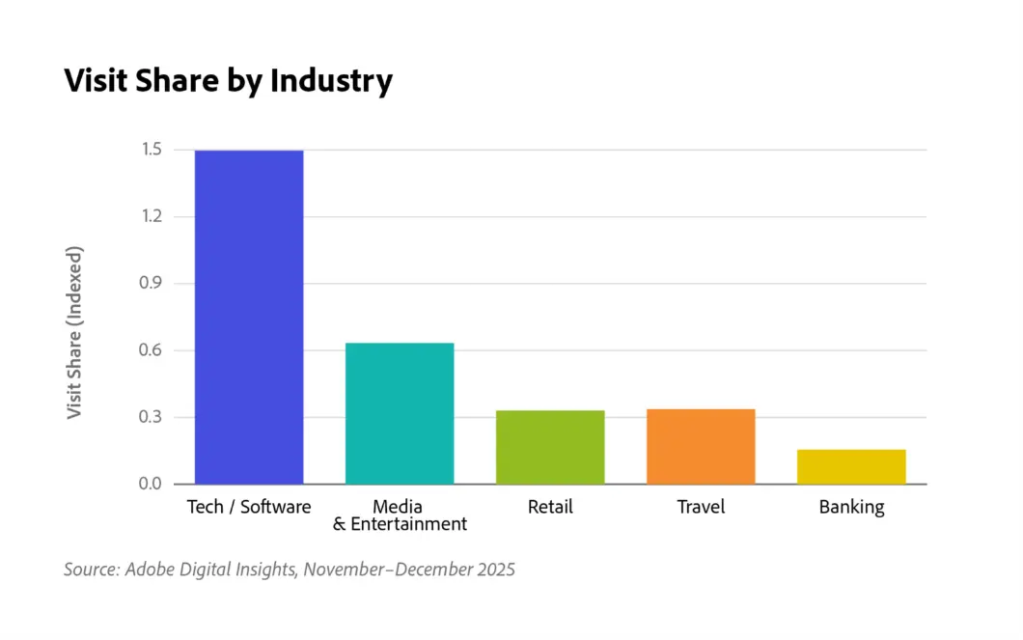
According to Adobe’s recent AI traffic tracker, AI-driven traffic grew multifold during the holiday season in 2025.
The report says that the retail segment saw a massive jump of 693% year-over-year. Other industries saw a similar exponential spike in traffic. Travel traffic grew over 500%, whereas the tech and software space saw 120% growth.
The report, which covered 1 trillion visits to US retail websites, noted that consumers are now leveraging AI for their online shopping journey, ranging from discovery and product research to making the final purchase.
One of the most intriguing takeaways from the Adobe report is that AI traffic is not just limited to browsing and researching, but is actually converting.
“That deeper engagement translated directly into higher conversion during the 2025 holiday season. AI referrals moved from lagging to leading, converting 31% more than other traffic sources—nearly doubling YoY. This is in addition to a significant boost in AI-driven revenue per visit (RPV), which is up 254% this holiday season year-to-date. Key shopping events widened the gap: AI conversions were 54% higher than non-AI on Thanksgiving and 38% higher on Black Friday,” Vivek Pandya of Adobe writes in a post.
ALSO READ: Pine Labs Launches ‘India’s First Autonomous Agentic Payment’, P3P
Even as Adobe’s data reveals the shift in the West, India is set to follow suit as mentioned-above several local enterprises are now pivoting to AI discovery. Though, there will be a lot of behavioral change, not only from the consumers’ point of view but businesses too.
Speaking to Entrepreneur India, Vikas Garg, Co-founder and CPO at Kapture CX, said: “The hardest adjustment won’t be technical, it’ll be trust. For two decades we trained people to scan ten links and judge for themselves. Now they get one synthesized answer and have to decide whether to believe it. That trust gap is the real friction, and it’s earned through accuracy and transparency about sources, not through how fluent the answer sounds.”
Jaspreet Bindra, co-founder of AI&Beyond, adds: “The biggest challenge will be trust. Traditional search offered multiple links to compare, while AI often provides a single, confident answer that may not always be accurate. In India, incorrect information about government schemes, exams, or local regulations can have serious consequences. Add multilingual queries, code-mixed languages, and diverse accents, and accuracy becomes even more challenging. Users will need to verify AI-generated answers rather than accept them at face value.”
India’s AI
Indian businesses are gradually entering the AI-first search era. Think of the impact on Indian retailers and small businesses listed on Amazon or similar large e-commerce websites that are also pivoting to AI search.
Amazon has introduced something called Rufus, a genAI shopping assistant. Now directly integrated within Amazon’s e-commerce ecosystem, it is designed to help users make more informed buying decisions with, of course, contextual searches and conversations.
This means businesses must change the way they approach listing discovery and so on.
Dr. Srinivas Padmanabhuni, CTO of AiEnsured, tells Entrepreneur India that brands need to optimize for AI, not just search engines. They should publish trustworthy, structured, and conversational content, keep business information updated, and build credibility through reviews and expert content.
ALSO READ: Breaking Down Agentic Payments, UPI’s AI Moment, And More
For example, instead of targeting the keyword “best broadband plans,” a brand should answer questions like, “Which broadband plan is best for a family working from home with multiple devices?”
“Brands should also ensure their content is easily understood by multilingual and Indic LLMs, increasing the likelihood of being cited in AI-generated responses,” Padmanabhuni added.
Garg notes that the old model was simple—rank high and win the click. But that model starts to break down when AI answers queries directly. For local businesses that relied on SEO traffic, the game shifts from being found to being cited as the source.
“The winners won’t be the ones with the best keywords, they’ll be the ones with the strongest real-world signals: genuine reviews, accurate listings, and an authentic local presence. Done right, this actually levels the playing field against competitors with bigger ad budgets,” he added.
Experts believe that generative search—as of now—will recommend only a handful of businesses instead of showing long lists, making visibility far more competitive.
For example, if someone asks, “Recommend a budget-friendly vegetarian restaurant in Indiranagar that is open after 10 PM with parking,” AI may suggest just one or two places.
And this makes things complicated for smaller businesses. According to Garg, such entities should keep their profiles updated, publish accurate menus, pricing, hours, and contact details, use structured data, and encourage authentic customer reviews. Businesses with complete, trustworthy, and AI-readable information will have a much better chance of being recommended.
Nishant Das, founder and CEO at Cheerio AI, says: “Contextual search will become table stakes much faster than people expect because users won’t go back to fragmented experiences after seeing what’s possible. However, not every query needs a frontier model. Most companies will adopt hybrid architectures—traditional search for simple lookups, lightweight AI for summarization and larger reasoning models only when complexity justifies the cost. Over time, context will become a bigger competitive advantage than raw model intelligence because knowing the user’s history, preferences and goals is often more valuable than generating another paragraph of text.”
What’s Likely
It’s safe to assume that the future is going to be a conversational digital space. And as mentioned above, brands have to make several changes to their approach to structurally align with the future in order to win.
Padmanabhuni gives a much more elaborate overview of what’s likely to happen in the future:
“Advertising will increasingly shift from clicks to completed actions. Instead of showing sponsored links, AI may recommend products or services directly within the conversation.
For example, if you ask, “Book a family hotel in Goa under ₹6,000,” the AI could recommend a sponsored hotel and let you complete the booking within the chat via agentic AI. Brands will increasingly pay for completed bookings, purchases, subscriptions, or qualified leads, making conversational commerce and outcome-based advertising the next evolution of digital monetisation.
Five models replacing older ways:
Cost-Per-Outcome (CPO/CPA): The brand pays only when AI completes a booking, purchase, install, or qualified lead.
Conversational Product Placement / Sponsored Answers: Brands pay to be the default recommendation when intent matches, similar to slotting fees in retail.
Agent Tolling / API Access Fees: Brands pay AI platforms for real-time API access so the agent can check inventory, pricing, and complete bookings.
Subscription and Take Rate Hybrid: The user pays for AI, and AI takes a 1 to 5 percent cut of any commerce it facilitates.
Data/RAG Licensing and Preference Auctions: Brands pay to have their catalogs, reviews, and policies ingested as high-trust RAG sources.”
That said, conversational commerce and agentic actions are now replacing the conventional click-and-scroll ecosystem. Businesses have to proactively adapt to survive these changes, and ensure their monetisation – if heavily banked on the older ways – does not get severely impacted or shifts to something else altogether. The surge in AI traffic and conversion seems likely to continue this year and in the future.
Search is changing. Nearly everywhere on the web.
You must have already experienced the change when you searched for anything on Google. The familiar search along with the knowledge graph is now transitioning to something called “AI mode.”
With users getting more contextual information and an immersive experience under AI overviews, brands relying on classical listings on Search for discovery, branding, marketing, and sales are bearing the brunt. But then, there could be some good to it as well. More on that in a bit.