Inside Gupshup’s Next AI Bet to Power Enterprise Communications
Gupshup is gearing up for the new AI era by leveraging its multi-channel messaging infrastructure and deep integration with enterprise backends.

Gupshup
Opinions expressed by Entrepreneur contributors are their own.
You're reading Entrepreneur India, an international franchise of Entrepreneur Media.
How businesses talk to customers, and vice versa, has radically changed over the years.
From desktop-based web browsers to mobile-first platforms, the evolution also reflects how consumer and enterprise technology has changed. Today, we are in the era of generative and agentic intelligence, a time when conversations must move beyond a robotic tone to provide personalized and contextual experiences.
Gupshup is among the few companies which have had a front-row seat to observe this evolution. Founded by serial tech entrepreneur Beerud Sheth, Gupshup existed in an era when mobile internet was still in its infancy and messaging was constrained to SMS with character limits.
Now, Gupshup is gearing up for the new era by leveraging its multi-channel messaging infrastructure and deep integration with enterprise backends.
It also has an early-mover advantage, of sorts, through its participation in Meta’s private beta ecosystem and its deployment of the world’s first enterprise implementation of Meta Business Agent with Treebo Hospitality Ventures.
According to the company, nearly every user arriving through Click-to-WhatsApp ads chose to continue the conversation in the pilot.
Users spent a median of 11 minutes interacting with the agent, with some conversations extending beyond 30 messages. Around 70% used it to search for hotels, while others browsed images, compared options, and explored pricing.
The Evolutionary Arc
As mentioned above, enterprise communications have undergone cyclical changes, at least in the last three decades or so.
In the early days of the digital era, frameworks were web-centric and email-first, especially in the West. In emerging markets like India, the trend was different, where a generation of digital users simply skipped the PC era to embrace mobile connectivity.
Sheth recalls the early days of connectivity that also shaped Gupshup’s core strategy:
“The US was very web-centric, but the emerging markets were all mobile-first, messaging-centric ecosystems. And as the next billion were getting online, the only way to engage all these people was through mobile messaging, because they did not use the web or email as much,” Sheth tells Entrepreneur India.
If you have followed India’s digital journey, you’d find the “next billion” phrase quite familiar. It essentially referred to the massive set of users in developing countries who were fast getting connected to the internet and using smart handheld devices.
With each set of evolutionary phases, the way business-to-consumer conversations happened also evolved.
In the first phase of things, SMS drove communication. Looking back, it’d appear very simplistic, just push notifications or alerts. It was pretty much one-way communication, and brands did not have a lot of insights into the responses to these.
In the second phase, wherein WhatsApp took over peer-to-peer communication, communication became two-way in a primitive way. For instance, you had buttons to proceed, reschedule, or cancel. While WhatsApp-based communication has evolved and become more dynamic, it’s likely to be phased out by agentic AIs.
This brings us to the modern era, wherein brands can have much more dynamic, autonomous, and context-aware communication with users, and vice versa.
Sheth explains this trajectory with a practical scenario:
“In the early days, it was SMS which is now primitive. It was mostly one-way communication with a little bit of two-way communication. But then WhatsApp started enabling it as well, so then it became two-way and much richer. And then with the rise of AI, it’s actually very intelligent. So even in the SMS era, you’d get a message saying, ‘Hey, your flight is delayed.’ In the WhatsApp era, it’d say, ‘Okay, your flight is delayed. Here are three options, pick one… reschedule or cancel or refund or whatever.’ And now in an AI era, it’s like, ‘Okay, oops, we’re sorry, but here’s a discount, what would you like? Here are different options, and you’re a premium customer, we can do something special for you,” he explained.
Even as WhatsApp had just begun taking off, Gupshup was quick to identify the potential of the instant messaging platform. It also partnered with Meta to bring richer experiences to the platform.
“…Meta liked what Gupshup was doing… they were adding features, we were adding features, and ultimately customers were benefiting. We ended up becoming one of the biggest WhatsApp platforms for enterprises…” Sheth added.
At least in India, WhatsApp has emerged as the de facto messaging platform for individual users as well as enterprises.
According to an estimate, there are over 25 million WhatsApp Business user accounts, while over 2 lakh entities like banks, e-commerce platforms, healthcare service providers, and others use the WhatsApp Business API for chatbots or customer support. Globally, 5 million organizations are estimated to use the API.
Meta recently introduced business agents. Now available in India, the business agent on WhatsApp is said to be designed to handle key customer interactions end-to-end around the clock, including: “Answering questions specific to the business; Making product recommendations from the business catalog; Booking appointments and qualifying incoming leads; Enabling business owners to decide when a team member steps in to provide support Helping close sales.”
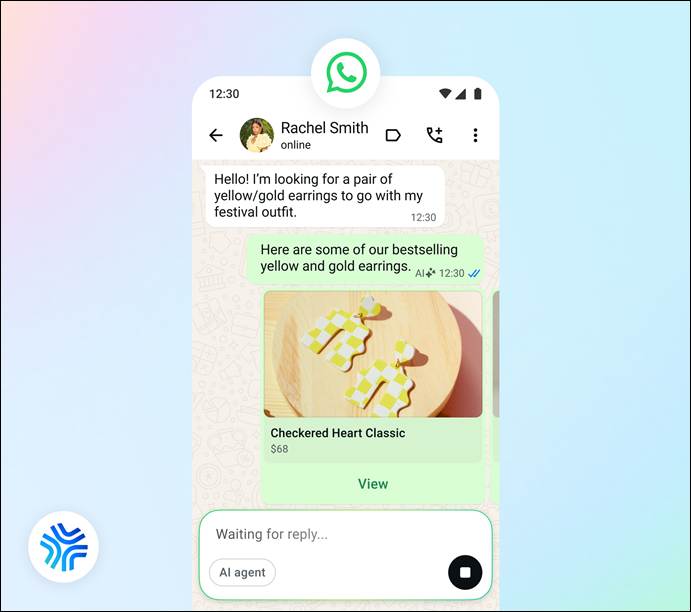
Meta Business Agent also acts as a partner for business owners—surfacing insights from customer conversations and providing summaries of missed interactions, helping businesses stay on top of their operations and focus on growth.
For larger businesses, Meta is offering a Business Agent Platform, which is said to enable enterprises to build and customize AI-powered agents while integrating with existing business systems such as Shopify, Zendesk, and Shopee. Working alongside the WhatsApp Business Platform, it is said to provide enterprise-grade scalability, controls, and measurement.
Evidently, WhatsApp or any other medium used to reach customers will soon be powered by such intelligent agents.
Enterprise Moat
Of late, thousands of AI wrappers and bots have flooded the market, and Gupshup is aware of it as well. The company is betting on its tried and tested infrastructure that can scale up for large enterprises.
Sheth tells Entrepreneur India that the company has 50,000 clients across more than 100 countries and processes upwards of 10 billion messages per month. Naturally, it’s harder for smaller players to match that scale.
“It’s all very high scale, high volume, high reliability across different countries with rich and complicated orchestration and journeys and campaigns and workflows… And now with AI, we’ve built out all of these things…” he said.
“… How do we continue to win in the market? We have some of the largest customers, we have the most scale, and then we are also innovating a lot… We of course work on WhatsApp, but also on RCS, also on SMS, and then Voice and Voice AI capabilities. There are very few companies that can offer the full range of capabilities. The way I like to describe it is Gupshup’s moat is this combination of incumbency and innovation. Meaning, we already have like these large number of existing customers, which is great, and then we are also innovating. Most incumbents are not innovating, and most innovators, like new AI companies, they don’t have the relationship, right? In our case, we just take it to our existing customers, that already gives us a lot of scale,” he added.
Under the Hood
Gupshup’s architecture is not overly complex and relies on all kinds of AI models at hand to power its agentic conversational engine.
“We use all kinds of AI models… It’s not any one company,” Sheth explains. “Our engineering teams will keep testing and using different models to see what’s the best fit for what purpose. And the answer is not even a single model, but it’s a collection of models for different purposes. If it’s a simple query, it could be a simpler model… if it’s a more complex query, you need a reasoning model.”
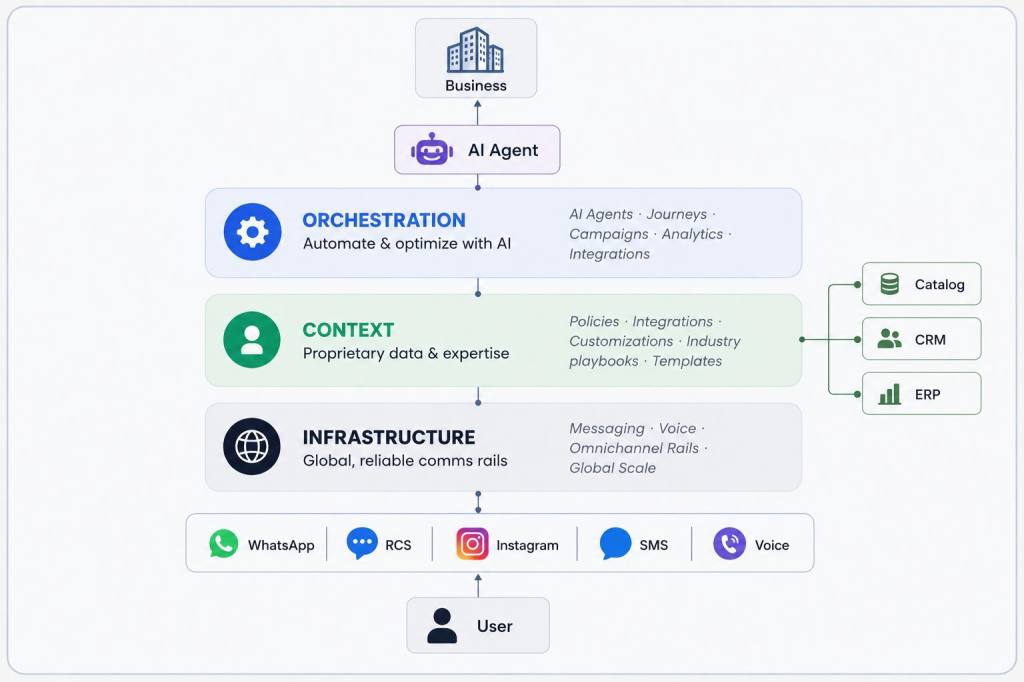
Model intelligence, which is pretty much raw in its original form, needs enterprise connectivity. Gupshup uses a multi-tiered platform stack to bridge this gap. Sheth further simplifies the architecture into three core layers:
“One layer is like the infrastructure piece… simply the ability to send and receive messages… Then, the next layer up is like a context layer, meaning it has a lot of knowledge and insights, and understanding… And then, the third layer is the orchestration layer, where… you can set up campaigns and journeys and workflows and analytics… to put it all together.”
Gupshup
These layers are then stitched together, essentially making modules like AI agents, campaign managers, and analytics engines talk to each other, subsequently helping Gupshup deliver a seamless experience.
“We build individual lots of modules, then we connect it internally, and then we also connect it externally to… the customer systems,” Sheth notes. “This is building out a sophisticated, complex platform and making it work right.”
Behind the Scenes
Sheth explains how the new regime will work for businesses with an example:
“When you work with a bank… It might look like one company, but behind the scenes, there are like thousands of people. There’s somebody who’s your relationship manager, there’s somebody who’s managing loans, there’s somebody who’s managing credit cards… each one has their own responsibility… and then it all works together,” he explains.
In Gupshup’s framework, individual modules replicate these specialized departments, while an overlying engine acts as the executive controller routing tasks behind the scenes.
“When we build a system, what we’re doing is we’re building a lot of different modules… And then there is an orchestration engine at the top, it’s like the CEO,” Sheth says. “If the query is, ‘What’s my balance?’ the orchestration system says, ‘Oh, okay, this requires us to go look at the banking system, the back end… and then reply to the user.’ But then the user says, ‘Can I get a discount?’ Then the orchestration engine says, ‘Okay, this one, maybe the marketing team can answer…'”
Whether a customer wants to check an account balance, inquire about a promotion, or log a formal complaint, the orchestration layer directs the request to the right module and synthesizes the response into a single, cohesive interface.
“You have each module [that] has its own responsibility, and then you do the orchestration on top of it, so that… for the end user, it looks very sort of well-coordinated. Orchestration means… you’re doing a lot of complex things, but for the end user, it looks all coordinated,” Sheth notes.
Going Forward
Even as Gupshup has ambitious plans for the AI era, the company has also seen valuation markdowns. Earlier this year, US-based asset manager Fidelity Investments marked down the valuation to USD 300 million, significantly lower than its peak of over a billion-dollar valuation.
Gupshup’s India unit generated INR 1,943 crore in revenue in FY25, while profits stood at INR 26 crore in the same period, according to Entrackr.
Sheth, however, is unfazed by this. He notes that more than half of its business comes from outside India. He also noted the different paces of adoption of conversational AI across different markets.
“… the overall business is growing really well, even if some parts of the business may not be growing, because, obviously we want to prioritize good customers with good margins and with sort of higher quality business?… Our goal is not to be the cheapest, it’s to be the best. … We are very diversified across different geographies, across different industries and verticals, and we focus on building a high-quality business, and scaling it up, and driving a lot of innovation, and leveraging a lot of AI and things like that. What you see in India is just a a partial picture. It’s not the full global picture,” he noted.
With AI completely in sight, Gupshup is on the verge of releasing a lot of easy-to-use, self-serve products. The objective is to make it very quick and easy for businesses to get started with conversational AI.
“It’s simple and quick… which means even like a really small business or a Kirana store or a restaurant, and of course, large businesses like, you know, banks and retailers, they can, uh, you know, they can use it and do it,” he added.
“So, we are very excited about basically making it accessible…. How can we take AI and make it useful to every business and every consumer in India…. And not just India, many other countries around the world? If we can really make their lives more productive and bring more value to them, I think that’s really our mission…” he said.
How businesses talk to customers, and vice versa, has radically changed over the years.
From desktop-based web browsers to mobile-first platforms, the evolution also reflects how consumer and enterprise technology has changed. Today, we are in the era of generative and agentic intelligence, a time when conversations must move beyond a robotic tone to provide personalized and contextual experiences.
Gupshup is among the few companies which have had a front-row seat to observe this evolution. Founded by serial tech entrepreneur Beerud Sheth, Gupshup existed in an era when mobile internet was still in its infancy and messaging was constrained to SMS with character limits.