BIRAC Drives Biotech Growth with INR 4,200 Cr Funding Across 15 Lakh Innovators
The organisation has emerged as a key driver of biotech innovation by offering a mix of grant funding, equity support, mentoring, and partnerships.
BIRAC
You're reading Entrepreneur India, an international franchise of Entrepreneur Media.
The Biotechnology Industry Research Assistance Council (BIRAC), a public sector enterprise under the Department of Biotechnology (DBT), marked its 14th Foundation Day by highlighting its role in supporting India’s fast-growing biotechnology ecosystem.
Over the past decade and a half, BIRAC has facilitated funding of more than INR 4,200 crore, reaching over 15 lakh startups, entrepreneurs, companies, and innovators across the country.
The organisation has emerged as a key driver of biotech innovation by offering a mix of grant funding, equity support, mentoring, and partnerships. These initiatives have supported advancements across sectors such as biopharma, med-tech, agri-biotech, health-tech, industrial biotechnology, and clean technology.
A major component of BIRAC’s efforts has been its focus on incubation. Under its BioNEST programme, the council now supports 100 bio-incubators, providing more than 10.45 lakh square feet of incubation space. These facilities offer startups access to laboratories, pilot plants, regulatory guidance, and business mentoring. Many of these incubators are housed within leading universities and research institutions, while others operate as independent innovation hubs.
Officials noted that this infrastructure has enabled early-stage startups to test and validate their technologies more efficiently and move towards commercialisation. Alongside incubation, BIRAC runs several flagship schemes that support innovators through different stages of product development. These include the Biotechnology Ignition Grant (BIG) for early ideas, SBIRI and BIPP for product development, and PACE for transitioning academic research into enterprises.
The council also manages funding initiatives such as the AcE Fund, SEED Fund, and LEAP Fund, which provide equity and scale-up support. Specialised programmes like the Focused Area Initiative and Early Translation Accelerator aim to fast-track promising technologies.
Speaking at the event, Union Minister of State (Independent Charge) for Science and Technology, Dr Jitendra Singh, highlighted the rapid growth of India’s bioeconomy. “As BIRAC celebrates its 14th Foundation Day, we reflect on India’s remarkable biotechnology journey, from an emerging field to a powerhouse driving national growth,” he said.
He added, “Our bioeconomy has surged from USD 10 billion in 2014 to USD 165.7 billion in 2024, and continues to grow to USD 195.3 billion in 2025, reflecting an 18% year-on-year increase. Institutions like BIRAC have been pivotal in translating vision into outcomes through innovation, partnerships, and robust ecosystems.”
Dr Singh also emphasised the importance of biotechnology in India’s long-term development goals. “Biotechnology is central to Viksit Bharat @2047, and the BioE3 Policy charts a transformative roadmap, positioning India as a global hub while advancing healthcare, food security, climate resilience, and biosecurity,” he said.
Dr VK Saraswat, Member of NITI Aayog, noted the sector’s transformation over the past 14 years. He said that BIRAC has played an “extraordinary role in building a robust innovation ecosystem that delivers global-scale solutions from Indian labs,” adding that the organisation has helped nurture ideas from research to market.
Dr Rajesh S Gokhale, Secretary of DBT and Chairman of BIRAC, highlighted the scale of impact achieved so far. “In just 14 years, BIRAC has helped transform Indian biotechnology from a small, fragmented sector into a vibrant innovation-driven ecosystem,” he said.
“By catalysing INR 7,000 crore in total investment across lakhs of startups and companies, BIRAC has supported the development of over 900 products. We have created more than 35,000 high-skilled jobs and demonstrated that India can produce globally competitive science and technology,” he added.
Dr Gokhale also announced BIRAC’s expanded role under the national Research, Development, and Innovation (RDI) framework. “BIRAC has now been entrusted as a second-level fund manager, with a mandate to deploy INR 2,000 crore over the next five years. This will help support deep-tech companies at later stages and build a full pipeline from proof-of-concept to scale-up,” he said.
Industry experts at the event also pointed to the growing impact of biotechnology in agriculture and sustainability. Prof. Ashok Jhunjhunwala of IIT Madras said, “Startups in our country are thriving, and the momentum ahead looks very promising. Among the many innovations, biopesticides stand out as a game-changer, helping boost farmer incomes while strengthening environmental resilience.”
Dr Jitendra Kumar, Managing Director of BIRAC, underlined the organisation’s long-term vision. “BIRAC’s mission has always been to de-risk innovation for entrepreneurs, whether they are first-time founders, academic innovators, or MSMEs working on deep-tech solutions,” he said.
He added, “What sets our model apart is the seamless integration of funding with incubation, regulatory guidance, IP support, and market linkages. Our ambition is to grow India’s bioeconomy to USD 300 billion by 2030 and USD 1 trillion by 2047.”
A key policy initiative supporting this growth is the BioE3 Policy, approved in August 2024. The policy aims to position India as a global hub for sustainable biomanufacturing by promoting advanced manufacturing systems and bio-foundry infrastructure. It also encourages collaboration between startups, industry, and academia while reducing costs and time-to-market for bio-based products.
Early responses to BioE3 programmes have been strong, with thousands of proposals submitted in areas such as green chemicals, biofuels, and sustainable materials.
India’s biotechnology sector has seen steady growth, currently ranking among the top 12 globally with a compound annual growth rate of 17.8 percent between 2020 and 2025. The country now has over 11,855 biotech startups, reflecting a rapidly expanding innovation landscape.
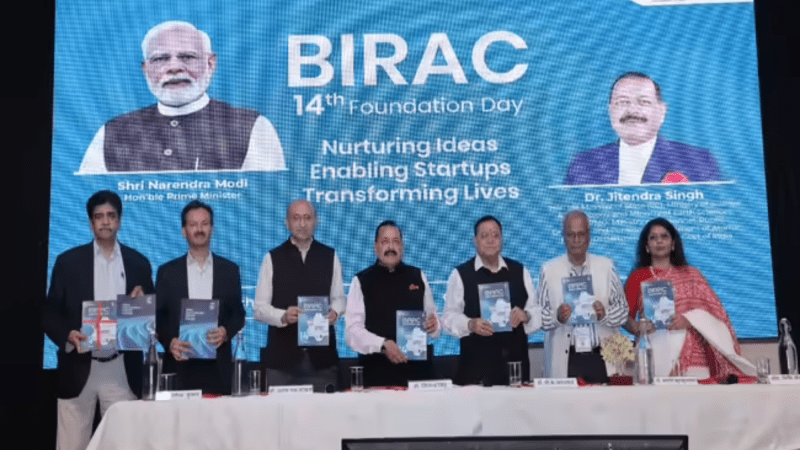
The Foundation Day event brought together policymakers, scientists, and industry leaders, and also marked the release of the BIRAC Impact Report and the India BioEconomy Report 2026. These reports outline the progress made in the sector and provide insights into future opportunities, reinforcing the role of biotechnology in India’s economic and scientific advancement.
The Biotechnology Industry Research Assistance Council (BIRAC), a public sector enterprise under the Department of Biotechnology (DBT), marked its 14th Foundation Day by highlighting its role in supporting India’s fast-growing biotechnology ecosystem.
Over the past decade and a half, BIRAC has facilitated funding of more than INR 4,200 crore, reaching over 15 lakh startups, entrepreneurs, companies, and innovators across the country.
The organisation has emerged as a key driver of biotech innovation by offering a mix of grant funding, equity support, mentoring, and partnerships. These initiatives have supported advancements across sectors such as biopharma, med-tech, agri-biotech, health-tech, industrial biotechnology, and clean technology.

Entrepreneur Staff • Editor
Entrepreneur Staff
For more than 30 years, Entrepreneur has set the course for success for millions of... Read more