Skyroot’s Historic Vikram-1 Launch: Key Things to Know
In May this year, Skyroot became India’s first space-tech unicorn after raising USD 60 million (around Rs 570 crore) in a funding round.
skyroot
You're reading Entrepreneur India, an international franchise of Entrepreneur Media.
Skyroot Aerospace created history as it became the first private company to fly an Indian-built rocket to orbit on its maiden attempt.
Mission Aagaman, meaning ‘arrival’, lifted off from the First Launch Pad at the Satish Dhawan Space Centre, Sriharikota, and Vikram-1 flew a nominal profile to reach its target Low Earth Orbit of approximately 450 km at a 60-degree inclination, where it successfully deployed its payloads.
In doing so, Skyroot joined the exclusive group of companies able to reach orbit.
Prime Minister Narendra Modi called the Skyroot team to congratulate them on the success.
“I extend my heartfelt congratulations to Team Skyroot on the successful accomplishment of the Vikram-1 mission. This achievement is the outcome of years of innovation, perseverance and engineering excellence, and reflects the growing maturity of India's private space sector. It is encouraging to see Indian industry translating technological capability into launch capability, complementing our national space programme. ISRO and IN-SPACe remains committed to working closely with industry partners to build a vibrant, globally competitive space ecosystem that advances India’s space ambitions,” Modi said in a note to the Skyroot team.
Pawan Kumar Chandana, Co-founder & CEO, Skyroot Aerospace said, “During the flight, Vikram-1 completed every principal mission milestone, validating the performance of its propulsion, avionics, and guidance, navigation and control systems under true operational
conditions. The vehicle deployed its customer payloads and generated a wealth of in-flight data that will directly inform future Vikram missions and the continued evolution of Skyroot’s launch programme.
Mission Aagaman is the culmination of years of engineering, rigorous testing and an unwavering commitment to solving some of the hardest problems in Space. Every milestone today reflects the dedication of hundreds of engineers, technicians and mission specialists who believed in pushing the boundaries of what was possible…”
Skyroot’s success opens up a new window of opportunity for private Indian space players to accelerate their product development, R&Ds, and more.
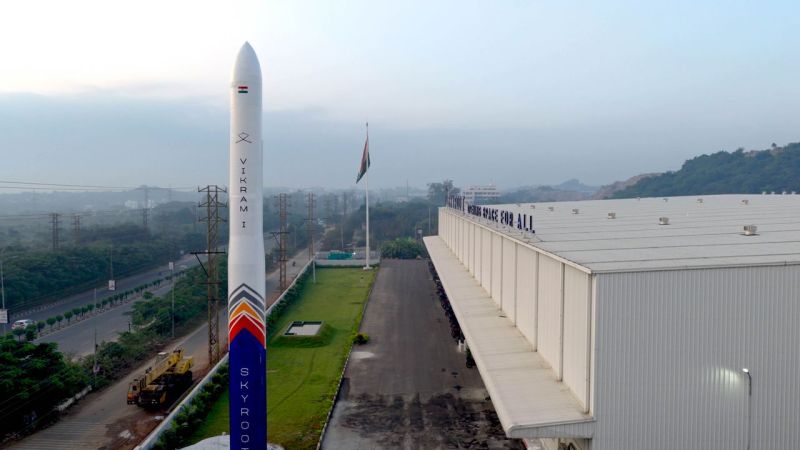
Vikram-1
Vikram-1 is a seven-storey-tall, multi-stage orbital launch vehicle built around an all-carbon-composite structure and powered by in-house-developed propulsion, including 3D-printed engines and high-thrust solid-fuel motors — and is designed to carry small satellites of up to 350 kg to Low Earth Orbit.
Its ultra-low-shock, ground-testable separation systems are engineered to protect the delicate satellites it carries. On this flight, Vikram-1 carried technology-demonstration payloads from Grahaa Space, Cosmoserve and DCubed, alongside Skyroot’s own SCOPE satellite, together with Cosmos Diamonds’s artwork ‘Cosmic Bloom’ and a micro-art piece.
The beginning
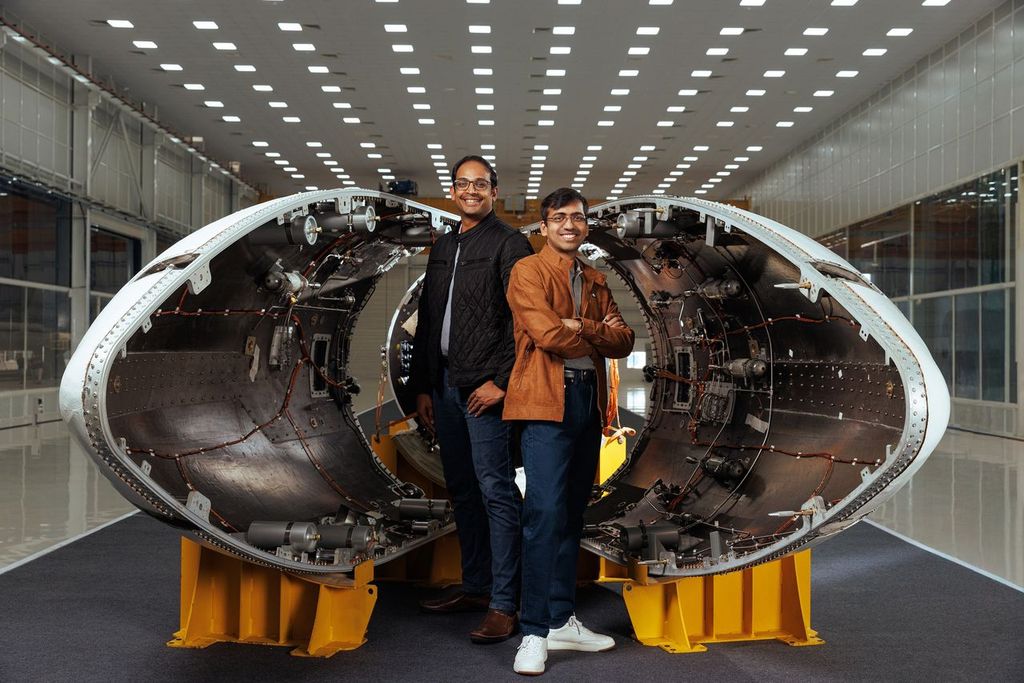
Founded in 2018 by space scientists-turned-entrepreneurs Pawan Kumar Chandana and Naga Bharath Daka, Skyroot aims to make space launches as accessible and routine as commercial air travel. The company has set up its headquarters in Hyderabad. Skyroot recently opened a campus in Aero Towers (10,000 sq. ft.) in Hyderabad, Telangana.
Mission Prarambh
Back in 2022, Skyroot scripted history by launching India’s first private rocket, Vikram S, under its ‘Mission Prarambh’.
The single-stage solid rocket reached a peak altitude of 88.8 km and achieved a maximum velocity of Mach 5.07 during its 301.4 second flight.
Following a nominal ascent phase, the vehicle successfully completed its mission profile, splashing down 125 km downrange in the Bay of Bengal. The flight carried three customer payloads: BAZOOMQ Armenia, Space Kidz India, and N-Space Tech India.
Spacetech unicorn
In May this year, Skyroot became India’s first space-tech unicorn after raising USD 60 million (around Rs 570 crore) in a funding round co-led by Sherpalo Ventures and Singapore’s sovereign wealth fund GIC. BlackRock, Arkam Ventures, Playbook Partners, Shanghvi Family Office, and existing investors, including the founders of Greenko Group, also participated in the round.
According to estimates, Skyroot has raised over USD 160 million across funding rounds. Some of the other notable investors are Temasek, Mukesh Bansal, and Neeraj Arora.
Vikram 2
After the successful launch of the Vikram-1, Skyroot is now preparing for the Vikram-2, capable of carrying up to 1,000 kg to Low Earth Orbit, with its maiden flight targeted for 2027, and a fully reusable launch vehicle, with both booster and upper stage engineered for recovery and reuse, designed to lower the cost of reaching orbit still further.
Skyroot Aerospace created history as it became the first private company to fly an Indian-built rocket to orbit on its maiden attempt.
Mission Aagaman, meaning ‘arrival’, lifted off from the First Launch Pad at the Satish Dhawan Space Centre, Sriharikota, and Vikram-1 flew a nominal profile to reach its target Low Earth Orbit of approximately 450 km at a 60-degree inclination, where it successfully deployed its payloads.
In doing so, Skyroot joined the exclusive group of companies able to reach orbit.

Entrepreneur Staff • Editor
Entrepreneur Staff
For more than 30 years, Entrepreneur has set the course for success for millions of... Read more