Digital Gold: Regulatory Vacuum, Self-governing Body and UPI Growth
Digital gold players form self regulatory body, DPMACI.
Pixabay
Opinions expressed by Entrepreneur contributors are their own.
You're reading Entrepreneur India, an international franchise of Entrepreneur Media.
Indian digital gold players have banded together to form a self-regulatory organization (SRO) called the Digital Precious Metals Assurance Council of India (DPMACI).
The organization is led by public policy expert Nirupama Soundararajan, who joins as an independent chairperson. Its founding members include key industry names such as MMTC-PAMP, SafeGold, Augmont, PhonePe, BharatPe, MobiKwik, Gullak, LendenClub, and CRED.
The objective of the organization is to “enforce rigorous governance and engage government and policy stakeholders to ensure a transparent, accountable and consumer-friendly ecosystem. By doing this, the organization aims to uphold consumer trust while allowing a technology-first, dynamic growth path for the industry.”
“To ensure all members adhere to the highest industry standards, the DPMACI framework will ensure a 1:1 physical metal backing, verified through periodic audits and the requirement that all holdings conform to London/UAE/ Indian good delivery standards.”
The organization said it will also work towards setting up an Ombudsman framework to address customer complaints and timely redressals.
Addressing the Regulatory Vacuum
The inception of the SRO comes amid significant regulatory uncertainty. In November last year, the Securities and Exchange Board of India (SEBI) issued a caution to the public regarding digital gold.
In its letter, SEBI stated: “…It has come to the notice of SEBI that some digital/online platforms are offering investors to invest in ‘Digital Gold/E-Gold Products’. Digital Gold is being marketed as an alternative for investment in physical gold. In this context, it is informed that such digital gold products are different from SEBI regulated gold products as they are neither notified as securities nor regulated as commodity derivatives. They operate entirely outside the purview of SEBI. Such digital gold products may entail significant risks for investors and may expose investors to counterparty and operational risks…”
Despite these warnings, digital gold has gained substantial ground in the country. Zuhaib of Just Gold told Entrepreneur India that while official consolidated reporting is missing, the industry’s cumulative size is significant. Current estimates suggest Indian consumers hold roughly 45 to 50 tonnes of digital gold, valued at approximately INR 55,000 crore to INR 70,000 crore.
Growth has been further fuelled by UPI integration. According to a World Gold Council report, digital gold transaction values via UPI rose from INR 8 billion in January 2025 to INR 21 billion by December 2025, a nearly 3x growth.
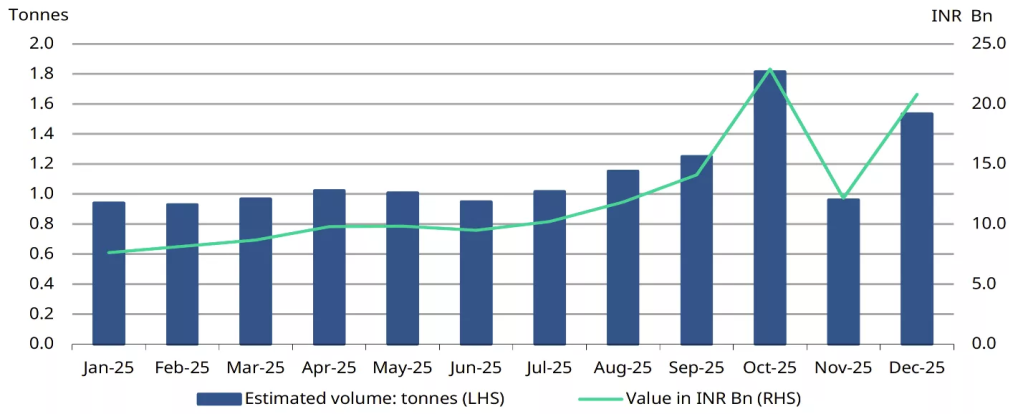
Source: World Gold Council
“Market feedback indicates that this growth has been supported by the ease of purchase, participation from a broader and newer set of buyers, and the expanding range of service providers, including jewellers and fintech platforms,” the report noted, adding that activity rebounded quickly after the initial SEBI caution.
Why Now?
The timing of the DPMACI’s launch quite curious. SafeGold founder and CEO Gaurav Mathur explained that authorities prefer engaging with an industry body over individual entities.
“We’ve also been applying to regulatory sandboxes since 2022. The current legislation is unclear about a framework to regulate digital sales of vaulted precious metal. The driver behind establishing the industry body is to create operating standards for consumer protection and serve as a platform for engaging with the government. The goal is to encourage the government to develop a formal regulatory framework for the sector,” Mathur added.
Mathur also detailed SafeGold’s internal safeguards: “Uniquely for SafeGold, all money from the sale of gold flows to a collection account controlled by the trustee (Vistra). The custodian (Brinks) sends a daily report of precious metal in the vault to the trustee. Only when the trustee sees precious metal corresponding to customer purchases, placed in the vault, is the money released from the collection account.”
Zuhaib noted that the formation of an SRO implies that the industry is acutely aware that formal regulatory intervention is coming, and this is a proactive attempt to demonstrate maturity and self-governance before that happens.
“Digital gold in India has crossed a scale where self-governance is no longer optional. When tens of millions of retail users are storing their savings in a product that sits outside any formal regulatory perimeter, the reputational and operational risks of inaction become very real. One significant fraud, one platform failure, one custody dispute that goes unresolved, and the entire category suffers,” he said.
Teeth
While the SRO appears to a step toward alignment with future guidelines, its efficiency remains to be seen, particularly regarding non-member companies. Mahendra Luniya, chairman at Vighnaharta Gold Ltd, noted that while members will face strict regulations, the status of non-members is unclear.
“As for those who choose not to become members, it remains to be seen whether the government will take any action against them or whether the council itself will be able to do so,” Luniya said. “However, becoming a member of this council will be important for enhancing the credibility and trustworthiness of each institution. The detailed rules are yet to be made public, and gradually, the various platforms and organizations operating in the digital gold sector are expected to become members of this council.”
The proposed Ombudsman also faces a massive logistical challenge: the sheer volume of microtransactions. Zuhaib pointed out that with monthly UPI purchases nearing INR 4,000 crore, many transactions are as small as INR 10.
“The grievance redressal pathway needs to be as simple as the purchase pathway. If it is not, the ombudsman exists on paper but not in practice,” Zuhaib added. “Three design principles matter here. The intake mechanism must be digital and app-native, living inside the same interface where the transaction happened. Resolution timelines need to be short and binding, a 30 to 45 day window is too long for a customer who cannot access INR 500 worth of gold they bought last week. And the ombudsman needs clear jurisdiction over the full transaction chain, including the fintech distributor, not just the vaulting platform.”
Abhinav Parashar, Co-founder & CEO, Digio adds, “The proposed grievance flow is already structured for digital scale, complaints are logged with mandatory fields and evidence, shared with the relevant platform within 5 business days, and targeted for response within 21 business days. However, micro-transactions present a unique challenge: they are high in frequency, small in ticket size, making them harder to investigate and easier to dismiss.”
“For the framework to be truly effective at this volume, it will need three critical enablers: strong automation for complaint intake and processing, a clear compliant taxonomy that can distinguish and route issues efficiently, and strict SLAs with defined escalation triggers and accountability. The bigger question is also one of ownership, when SLAs are breached, it must be unambiguous whether the platform, the council, or the ombudsman is accountable,” he added.
Having said that, the harder structural point is that an ombudsman works well when volumes are manageable and disputes are complex. Digital gold through UPI inverts that.
Most disputes are simple and volumes are enormous in this case. That profile is better handled by automated resolution systems, with the ombudsman as an escalation layer, not a first point of contact. DPMACI’s success here will be measured by the percentage of complaints resolved within seven days without human escalation.
Having said that, Digital gold startup Jar, one of the sector’s most prominent names with 35 million registered users is currently facing scrutiny in Karnataka. According to a Moneycontrol report, an FIR against Jar claims the startup collected money through an unregulated digital gold scheme.
Luniya also invokes recent appeal by PM Modi to postpone buying hold. Connecting the dots, he says, “Across India, an enormous quantity of unaccounted gold is lying idle in people’s homes. It is simply lying unused, without creating any real benefit for individuals, the country, or society. In such a situation, if gold becomes regulated in a digital format and people begin to trust these companies, then the idle gold lying in households can enter the market. This would allow people to buy and sell it in a much more efficient and transparent manner.”
ALSO READ: Iran War Strain: India Weighs WFH, Austerity Due to Energy, Economic Toll
“Every year, the value of gold imported into the country crosses nearly INR 10 lakh crore . At a time when such massive spending reduces liquidity from the economy, it becomes difficult for any country to sustain itself effectively. This is precisely why institutions of this nature are necessary. Digital gold needs to become mainstream and regulated. In fact, this is exactly what we have been advocating for over the last fifteen years.”
Indian digital gold players have banded together to form a self-regulatory organization (SRO) called the Digital Precious Metals Assurance Council of India (DPMACI).
The organization is led by public policy expert Nirupama Soundararajan, who joins as an independent chairperson. Its founding members include key industry names such as MMTC-PAMP, SafeGold, Augmont, PhonePe, BharatPe, MobiKwik, Gullak, LendenClub, and CRED.
The objective of the organization is to “enforce rigorous governance and engage government and policy stakeholders to ensure a transparent, accountable and consumer-friendly ecosystem. By doing this, the organization aims to uphold consumer trust while allowing a technology-first, dynamic growth path for the industry.”