Beyond UPI: How India’s Fintech Companies Make Money
Explore how India’s fintech companies are building revenue beyond UPI through lending, merchant services, payment gateways and financial product distribution.
freepik
Opinions expressed by Entrepreneur contributors are their own.
You're reading Entrepreneur India, an international franchise of Entrepreneur Media.
In today’s times, UPI usage has become a crucial part of our day-to-day payments, which leads us to wonder how these apps are making money from our UPI transactions, or whether they are really making any money with each transaction. India’s Unified Payments Interface (UPI) processes billions of transactions every month, yet the fintech companies powering this surge earn almost zero direct revenue from standard peer-to-merchant transfers. This paradox forced fintech giants and startups to rethink their business models and look beyond raw payment volumes. Rather than treating payments as a standalone profit center, companies now use UPI as a low-cost customer acquisition funnel to cross-sell higher-margin financial services. Now the central question is how Fintech companies are making money and running their business.
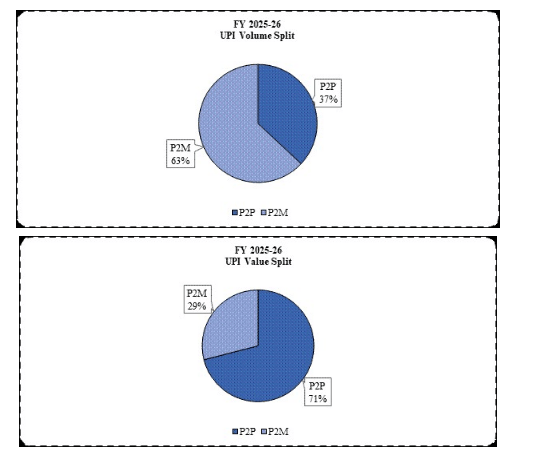
UPI transaction split: P2M (Person to Merchant) accounts for 63% of transaction volume, while P2P (Person to Person) contributes 71% of transaction value in FY26.
To build sustainable businesses under the zero-MDR regime, fintech companies are expanding beyond payment transactions and developing multiple revenue streams around their payment networks. One key source is payment gateway services. While standard UPI transactions do not generate merchant discount revenue, companies earn fees on credit card, debit card, net banking and digital wallet transactions. They also charge businesses for technology solutions such as payment routing, automated reconciliation and payment management.
The offline merchant ecosystem offers another source of recurring revenue. Companies deploy POS terminals and soundboxes at retail outlets, charging merchants monthly rental or subscription fees. Cross-border payments also offer higher revenue potential, with fintechs earning transaction fees and foreign exchange margins by facilitating international payments for exporters, SaaS companies and global businesses.
Fintech companies are also monetising their technology infrastructure through fraud prevention and identity verification services. They offer businesses KYC verification, bank account validation and real-time fraud detection tools through APIs, helping them manage risks and prevent fraudulent transactions.
However, a significant revenue opportunity lies in financial product distribution. Payment platforms use their existing merchant relationships and transaction data to connect customers with working capital loans, personal credit, insurance and investment products, earning commissions and origination fees. Paytm’s business model reflects this shift. Founder and CEO Vijay Shekhar Sharma said at Q22027 earnings call, “The company uses payments to acquire customers, while credit is a key revenue driver. We acquire using payments. Credit is what earns our money. Insurance and wealth deepen, and AI binds.” Payment flows help Paytm assess merchants and identify credit opportunities, allowing it to generate revenue beyond transaction processing.”
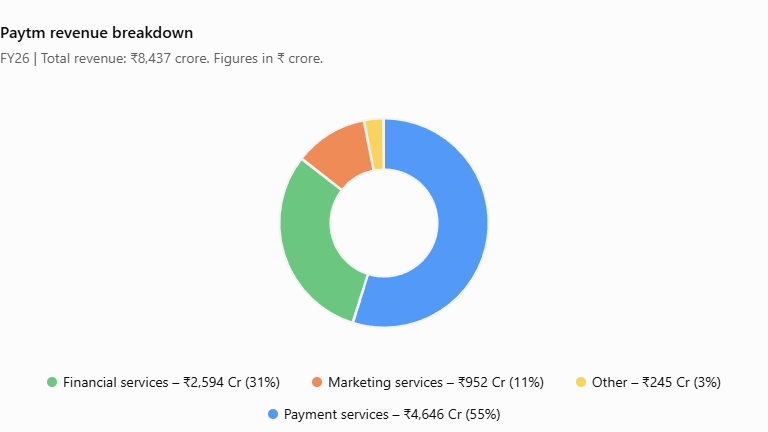
Here are some examples of Major Fintechs
| Company | Business focus | Revenue sources beyond UPI |
| Razorpay | Payments and business solutions | Payment processing fees, business banking, payroll, merchant loans and international payments |
| Paytm | Merchant ecosystem | Soundbox and POS rentals, loan distribution commissions, insurance and wealth products |
| PhonePe | Consumer and merchant services | Insurance and mutual fund commissions, merchant device subscriptions and payment gateway fees |
| Pine Labs | Retail payment solutions | POS services, EMI financing, gift cards and online payment processing |
Indian fintechs prioritize making more money from current merchants instead of concentrating primarily on increasing transaction volumes. By incorporating value-added services (VAS) within their customers’ daily operations, firms providing payment services move away from relying on low-margin processing fees and towards positioning themselves as high-margin providers of software, hardware, and lending products.
Beyond payment processing, fintech companies are generating revenue by offering merchants value-added services that improve business operations and payment efficiency. These include checkout optimisation tools such as pre-filled addresses, saved payment details, and smart routing, which help reduce cart abandonment and improve payment success rates. Cashfree’s One Click Checkout, for instance, combines these features with RTO intelligence and tools to increase order values. According to Cashfree co-founder, Reeju Datta, “Merchants using the solution have reported up to 50% higher conversions, a 65% higher share of prepaid orders and up to 30% fewer RTO orders. Because it grows their top line, merchants are willing to pay for it.”
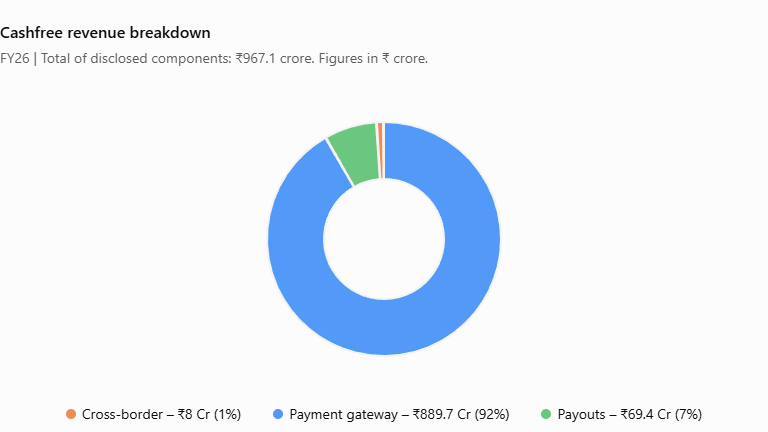
Other services include automated reconciliation and faster settlements, which help businesses track payments across channels and match them with bank statements. Fintechs also offer fraud prevention and compliance tools, including real-time risk assessment and KYC verification, to reduce fraudulent transactions and RTO (Return to Origin) losses. Some platforms are expanding into business software and banking services such as current accounts, payroll, vendor payouts, and subscription billing. They also use merchants’ transaction data to connect them with banks and NBFCs for working capital loans, earning commissions on successful loan distribution.
Running a payment business requires a lot of both fixed and variable investments behind the scenes. Companies need to set up a robust technological infrastructure that can cope with peak spikes in transactions while achieving almost 100% uptime and high payment success rates at the same time. They need to be constantly putting in money into cybersecurity, fraud protection, and compliance. Therefore, companies possessing larger merchant networks have a clear structural advantage since it allows them to spread heavy fixed compliance and cloud infrastructure costs over millions of businesses and decrease per-transaction costs while promoting high-margin financial products.
However, Can Indian fintech firms become profitable on a sustainable basis? Yes, diversifying into merchant services, cross-border payments and distribution of financial services is turning out to be commercially workable. Even JP Morgan and Goldman Sachs analysts note that a merchant-driven ecosystem can make EBITDA growth possible through mere rental of devices, SaaS, and credit distribution, with any income from UPI fees treated as a pure bonus.
In today’s times, UPI usage has become a crucial part of our day-to-day payments, which leads us to wonder how these apps are making money from our UPI transactions, or whether they are really making any money with each transaction. India’s Unified Payments Interface (UPI) processes billions of transactions every month, yet the fintech companies powering this surge earn almost zero direct revenue from standard peer-to-merchant transfers. This paradox forced fintech giants and startups to rethink their business models and look beyond raw payment volumes. Rather than treating payments as a standalone profit center, companies now use UPI as a low-cost customer acquisition funnel to cross-sell higher-margin financial services. Now the central question is how Fintech companies are making money and running their business.
UPI transaction split: P2M (Person to Merchant) accounts for 63% of transaction volume, while P2P (Person to Person) contributes 71% of transaction value in FY26.
To build sustainable businesses under the zero-MDR regime, fintech companies are expanding beyond payment transactions and developing multiple revenue streams around their payment networks. One key source is payment gateway services. While standard UPI transactions do not generate merchant discount revenue, companies earn fees on credit card, debit card, net banking and digital wallet transactions. They also charge businesses for technology solutions such as payment routing, automated reconciliation and payment management.