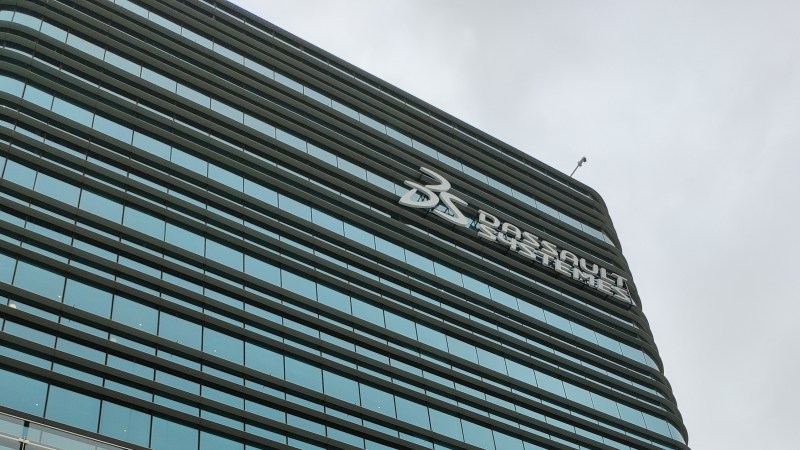
Dassault Systemes Doubles Down on India with Industrial AI, Deeptech Focus
Dassault’s move aligns with India’s evolving industrial landscape, courtesy the government’s push to local manufacturing across sectors
Entrepreneur India
Opinions expressed by Entrepreneur contributors are their own.
You're reading Entrepreneur India, an international franchise of Entrepreneur Media.
Dassault Systemes is executing a fundamental shift to its India growth strategy.
A short-term and long-term strategy in the works includes helping its customers leverage the company’s AI companions, exploring new segments such as deeptech and advanced manufacturing, and doubling down on the local research and development.
Speaking with Entrepreneur India, Dassault Systemes India MD Deepak NG shared an outline of the pivot—an amalgamation of new-age AI and the company’s deep expertise in virtual twins and advanced 3D design, simulation, and product lifecycle management—to tap into the India market.
According to NG, the execution strategy is focused on an “Invest in India for India” mantra along with the above-mentioned pillars.
From Backend to Growth Market
Dassault’s move aligns with India’s evolving industrial landscape, courtesy the government’s push to local manufacturing across sectors. Deeptech sectors, especially critical verticals like semiconductors, are being backed by a slew of initiatives such as Production Linked Incentives and India Semiconductor Mission.
Earlier this year, Dassault Systèmes CEO Pascal Daloz had said that India accounts for 5% of the company’s global topline, which is roughly USD 7.2 billion. Daloz also set an ambitious target of USD 1 billion from India, taking the contribution from the market between 12 percent to 14 percent.
During the company’s second quarter 2026 earnings conference call, the company disclosed that growth was strong in Asia at 8% with India as well as Korea and Japan driving the momentum.
In 2024, it partnered with Mahindra & Mahindra, indicating the India pivot.
The partnership also found a mention in the earnings call: “Mahindra & Mahindra expanded its deployments of the 3DEXPERIENCE platform on the cloud to modernize the product development across its global engineering organizations, but also to build the digital foundations ready to deploy AI-powered virtual twin at the enterprise scale. Their challenge is very simple. They want to reduce the time to market, and the value we bring to them is obvious. It’s connecting all the engineering teams across the ecosystems.”
Its India clientele is also quite diverse which includes names such as The ePlane Company, River Mobility, and L&T Energy Hydrocarbon.
The India impetus also includes a massive investment of Euro 100 million in expanding the company’s R&D base in Pune. Alongside Bengaluru, Dassault’s base in India currently houses nearly a quarter of the global workforce. The company now expects to double this number in the next three to four years.
In the meanwhile, the company is working with hundreds of Indian startups with support like limited time free license, mentorship, and more.
“From the revenue standpoint, we don’t declare India numbers, but what I can highlight is we are growing with higher double digits. We are growing higher double digits, and we have set ourselves an ambition on where we have to be. To do that, a few things are important in terms of the investments we are doing, the market we need to penetrate, and the solutions that are important for the Indian market. Keeping all these three things in mind, we are actually putting across a plan, both short-term and long-term,” NG told Entrepreneur India.
“If you look at the industries where we are strong, we continue to help our customers move towards the next generation—which is platform-on-cloud—and start taking advantage of the AI companions or the AI generative experiences that we have built. So, that is one focus, which is the current need,” NG continued.
“The second one is on the new segments. Particularly, segments like semicon and data centers are coming up. For example, medical devices and personalized patient care, we are already there, but we see a lot of scope in India, too. So, we are actually putting a dedicated focus towards that, so that the way we are supporting our core industries, we support these growth industries as well.
And most importantly, we’ll have to be closer to our customers. If I start focusing on India, can we also have a good amount of product research and development happen in India itself? That’s the reason, if you look at the investments we have made in this kind of campus, we call it ‘Invest in India for India.’ That means we have to also be faster to our customers in India with the right resources who can actually go and help them adopt, implement, and realize the right technology,” NG said.
Addressing how Dassault Systemes caters to startups without bringing in diluted tools, NG noted: “I will not say that we’ll bring lower-tier products, because whether it is a startup or a big company, nobody wants to compromise on quality and what they’re doing. Today, we have seen that startups are actually the ones without legacy…? They’re ready to adopt new technology… The advantage of Dassault Systèmes solutions is that they are all modular. Customers need not go end-to-end in the beginning—they can actually start with something small… Particularly for startups, we have amazing offers where they don’t feel the pinch of investing in the beginning. Gradually, they start leveraging the technology, and at some point when they grow, they can take a full-fledged solution. But whatever apps they use on the 3DEXPERIENCE platform, we will not compromise on quality or impose artificial limitations.”
Industrial AI
Dassault Systemes’philosophy and approach to AI is quite different from the trend. It’s focusing on something it calls “Industrial AI”. The objective is to build something that has the highest efficiency possible, given the scale of manufacturing demands. This is hard to achieve through typical consumer facing AI models.
“What you see in ChatGPT and all other things is consumer AI,” explains Sudarshan Mogasale, CEO of Dassault Systemes Solutions Lab. “When AI is applied to industries for really making a product—whether it’s a cup, cell phone, laptop, dress, or shoes… that becomes industrial AI… It is much more complex because it’s more deterministic. AI can make a mistake, but when you make a car, your car can’t have a bad part. We should make it really work.”
The Industrial AI stack aims to be quite comprehensive as much as possible. This is essentially an amalgamation of natural language interface, security and IP guardrails, Modsim Engine (deterministic engineering) and most importantly, an execution layer with platforms like CATIA.
Just for perspective, CATIA allows innovator social communities to collaborate virtually and co‑design experiences.
“Through its cyber‑physical systems modeling and simulation capabilities, CATIA is integral to 3DEXPERIENCE-based industry solutions for model‑based systems engineering, enterprise architecture, concept modeling, and ontologies,” according to the company.
“LLM is only from a human input to a machine input. After that, it is not LLM doing anything. It is actually our inside algorithms and we have created our own models… We embed the model inside, so it is not going out to third parties,” Mogasale further explains.
The company is also testing this limit internally through a self-developed AI software engineer copilot called Leo.
“We built our own assistant, we call it Leo Software Engineer,” reveals Mogasale. “Leo is our assistant which we sell to customers, but that version for a software engineer, we use inside the company to assist the development of software.”
Leo has already earned a reputation for its deep focus on standards, cybersecurity compliance, and verifies new code commits against legacy system architecture. This tool has altered developer workflows across Dassault’s Pune campus.
“Coding is creative for 10% of the time and very boring for 90% of the time,” Mogasale observes. “It’s such a pain to stick to the syntax, to compile, to debug… Now that 90% can go; it can become 30% or 40%. You get more creative time. We are not looking for coders; we are looking for engineers who can come up with products.”
Invest in India for India
Even though India foray is at its nascent stages, Shree Harsha, Senior Sales Director – Growth Industries tells Entrepreneur India that the Indian market is undergoing a key shift wherein new-age founders are emerging across industries.
“Instead of focusing on manufacturing-centric or e-commerce-centric, the next wave of Indian entrepreneurship will be on design,” Harsha states. “I feel it is the design.”
On chips, Harsha highlighted India’s national campaign to build the country as the next semiconductor hub. Dassault, according to Harsha, can play a pivotal role in this as the company operates at the intersection of mechatronics, chip packaging, and system integration.
“At the core of the semiconductor business is Dassault Systèmes’ knowledge on mechatronics,” Harsha explains. “We come from the domain of bringing in mechanical, electrical, electronics, and software together, and then seeing how systems behave.”
Dassault’s semiconductor coverage covers as many as four critical aspects:
Thermal-Mechanical & EMI/EMAG Simulation, which is simulating electromagnetic interface (EMI) and thermal-mechanical stress during wafer processing. Next up is IP Management Platforms which involves managing design complexities and protecting intellectual property across distributed engineering teams.
It also covers the OSAT Line Virtual Twins which is essentially modeling Outsourced Semiconductor Assembly and Test (OSAT) production lines to simulate manufacturing workflows before physical setup. And then Chip-to-System Packaging, which involves simulating drop tests, thermal dissipation, radiation, and electrical discharge when chips are integrated into end devices.
It’s worth highlighting that Dassault already works with global semiconductor leaders like Intel, Samsung, Lam Research, and STMicroelectronics among its clients.
In India, it is collaborating with state governments, such as Assam, to set up dedicated semiconductor Centers of Excellence (COEs). Apart from semiconductors, Dassault’s 3DEXPERIENCE is being now utilised by firms in sectors like drones, defence, and space-tech.
Pointing to drone innovations being built on Dassault’s stack, Harsha noted: “Five years ago when we ran drone hackathons, people were asking, ‘How will this fly? How to design the motor?’ Now, we are developing an entire drone in India. Raphe’s entire drone technology is designed using Dassault’s 3DEXPERIENCE platform.”
Road Ahead
Dassault is aggressively moving towards tapping into India’s deeptech boom. This is evident by its pivot and efforts like moving 3DEXPERIENCE platform to the public cloud and expanding its purview to a wide range of Indian startups.
Apart from commercial gains, the company is also looking at skill development through educational initiatives like AAKRUTI, and hackathons. As mentioned above, Dassault is reaching the early-stage founders with free software licenses along with tech mentorship.
“Unlike other players who take a stake in startups while providing help… we don’t do it,” emphasizes Shree Harsha. “Our pure play is only in a manner of enablement and support… We are more interested in them becoming more successful, going global, and becoming an innovation partner of that particular startup.”
That said, Dassault Systemes’ initiatives and pivot appear to be aligned with India’s USD 1 trillion manufacturing ambition wherein the fundamentals will bank on high-end R&D investment, data sovereignty, cloud-based Industrial AI tools, and new products and solutions from new and emerging deeptech companies.
Dassault Systemes is executing a fundamental shift to its India growth strategy.
A short-term and long-term strategy in the works includes helping its customers leverage the company’s AI companions, exploring new segments such as deeptech and advanced manufacturing, and doubling down on the local research and development.
Speaking with Entrepreneur India, Dassault Systemes India MD Deepak NG shared an outline of the pivot—an amalgamation of new-age AI and the company’s deep expertise in virtual twins and advanced 3D design, simulation, and product lifecycle management—to tap into the India market.