TIS 2026: The Promise, Potential & Impact of AI
TIS 2026: Speakers shed light on how AI is redefining the future of innovation and society.
Entrepreneur India
You're reading Entrepreneur India, an international franchise of Entrepreneur Media.
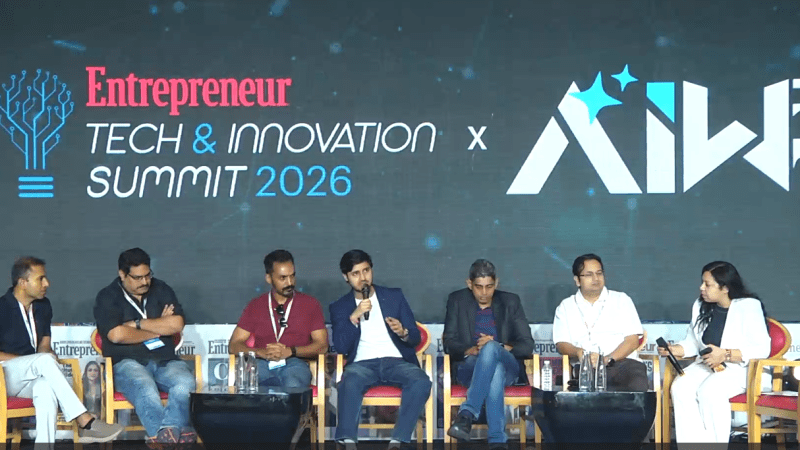
Artificial Intelligence (AI) was under the spotlight at the Entrepreneur India Tech & Innovation Summit 2026 held last month in Bengaluru. The two-day-long event saw marathon conversations and deep dives on multiple aspects of technology, innovation, and most importantly, the impact of AI.
Umesh Bude(CTO, Pocket FM), Satya Kaliki (CTO, Infra.Market), Avinash Basavarajappa (Senior Director, Engineering at ElasticRun), Himanshu Upreti (Cofounder & CTO, Ai Palette), Karthik Rajaram (General Manager and Country Head India, Eleven Labs) and Vipul Verma (Group Senior Vice President, TestMu AI) came together to discuss the promise, potential, and impact of AI on workforce, consumer behavior and lots more.
India as a consumer has already taken a lead in AI consumption. However, the next revolution is set to come with the technology becoming more accessible to all spectrum society, and in their native languages.
Rajaram’s Eleven Labs is making great strides in solving this challenge for Indians. He also described India’s linguistic multiversity as an unique advantage.
“When you look at Eleven Labs as a company, India is the largest enterprise market for Eleven Labs outside of the US and the fastest-growing as well. We’ve had a meaningful go-to-market presence for about four to five quarters, but we already have hundreds of customers, tens of millions of revenues, and growing really quickly; we’re growing our teams in India as well. The beauty about voice is, if you look at any interface, it makes certain inherent assumptions: it assumes that you can read, that you have a certain degree of literacy; it assumes that you can use a touchscreen; it assumes that you can walk through a 15-step flow on an app in a language that’s not yours,” he explained.
“Which essentially means that it just keeps out a large population of India, because for the smartphone urban population, GenAI works well, and our digital rails work well, but we’re excluding a large part of the population. But with voice, that does not make any of these assumptions. And when voice AI is done right, it structurally unlocks a lot for the 400 million Indians who want to interact with technology in their language, in their dialect. And that is the problem statement that we’re trying to solve for India,” he added.
Bude said that Pocket FM is leveraging AI to push the widely popular audio streaming platform. He added that the company is using AI for end-users as well as creators.
“If you look at the AI journey for Pocket FM, there are two parts to it. The first part is obviously on the end-user side: how do we get the right content in front of the right users, given we are in multiple countries, multiple geographies, multiple languages? Bringing relevant content to relevant users is extremely important. And over the time, we have gotten really good at it; it shows in our numbers. Now on an average, an end user spends like 140 minutes on the platform. So, that’s an insane kind of engagement we’re able to achieve. But the more interesting work we are doing is on the creator’s side. We have 300,000 writers on the platform. So, we are able to—and a lot of these are writers who have great stories but they don’t have writing skills, most of them are first-time writers. And that’s where our AI suite has been extremely helpful,” he said.
“We have built Studio, Writer Studio, with which first-time writers are able to write full-fledged stories. And our stories on our platform are long-form content; they are like 300 to 500-hour long stories. So, it takes a lot of skill. So, we are trying to get the story arcs from the writers, but we are providing them with all the tools to write those stories. Once the writing part is over, we also help them convert them into audio stories. And that way they are reaching millions of users. Some of the first-time writers are able to make 50 lakh per year now. So, that has been a huge story. So, writers are still at the center, but the AI suite has been massively helpful in making those stories realized and also taking it globally to millions of users,” Bude added.
That said, how deep AI can go, and beyond usual sectors? Kaliki of Infra.Market explains: “… the first layer of a problem for any AI-enabling endeavor is basically data. So, we all started with the first thing, like every generation, we did the workflows sorted first. If you don’t digitize the work, data is not going to flow through your system. So, we have evolved over time; so, over a six-year journey, it started with the basic stitching the workflows together, collecting data, building data, then identifying efficiencies through it. Now, effectively, the AI space has matured enough with enough data within the system; it’s able to make every persona within this workflow highly efficient in terms of organizing their day.”
Basavarajappa joins in with his perspective, especially on inclusion of the smaller cities of India.
“If you look at it almost a few years back, the GDP was growing very slowly; now the trend has become very different. And if you see the forecast and the current growth rate, compared to Tier-1, Tier-2 cities, the GDP is expected to grow multifold. Now, that creates its own demand. One of our main offering lines was: how do we ensure that some of the greatest of the brands—FMCG segments, whether it is ITC, Marico—how do we ensure those great products can reach deep rural areas? Because none of the brands want to build a connection pipeline; it doesn’t make sense because the ticket size will be small, it’s far deep and wide. So, how the AI and the supply chain network helped us is: it’s a multi-brand network with the right estimation,” he said.
“So, from a rural Kirana guy to the rural distributor hub, they don’t have to really know the data science or forecasting algorithm. So, what helps is based on the dynamic of the city, the festivals, and other aspects, he just needs to take a picture and video. The demand generation algorithm helps them to say that there is a ‘festival going to come, there’s rain going to happen, so why don’t you buy more umbrellas?’ and then he can place the orders. So, we made it very simple,” he added.
“There is this festival happening, there is this oil getting sold too much in the next village, I think you should stock the oil here also because you’re going to have a festival soon.”… these simple things help—see finally, how it needs to help the people who are touching is they should be able to do their work more efficiently, they should be able to earn more, and it should help their standard of living. And that’s the motto for our organization as well. How do we really bring this AI, make it a lot more simpler? And because of democratization and the GenAI framework, now we don’t need significant data science or models on our own to penetrate. One year or two years back, if I had to give a forecast just based on the video, it would have taken me at least 50x more effort to build that model; now it’s a lot more simpler,” he continued.
As far as AI for brand management goes, Upreti said there are multifold opportunities that are coming up thanks to the leverage of AI.
“…one is around velocity or speed, second is around hyper-personalization, and third is around autonomous decision-making. … Today I can, with the help of GenAI, create a personalized marketing campaign. Similarly, with the help of Eleven Labs, I can create a voice customized for each and every individual. So, that’s the hyper-personalization which is starting to become economically viable, and that’s where there are immense opportunities.
And last but not the least, the autonomous decision-making: again, the Agentic AI is playing a big role there, whether it is fine-tuning your marketing campaign once you have launched it and you are seeing the reaction in near real-time, or whether it is about your inventory or whether it is about any other decision that requires a human to be available 24/7—which obviously it can’t be—and that’s where the Agentic AI can help, because the agents can work 24/7, they don’t need coffee, they don’t need breaks, and they can, based on the logic that you have defined, they can help you in these autonomous decision-making which can then give you the benefit at the end of the day. So, these are the three areas which I see; of course, there are many-fold as well,” he said.
The IT sector, specially for processes like Quality Analysis, are likely to greatly benefit from AI.
Verma of MuSigma says, “if you see traditional QA, how it used to work earlier with the traditional software, it cannot fit with the software driven by AI. Because earlier, the software used to be deterministic: you give the fixed input, you get a fixed output. But with the AI in the picture, which is inherently non-deterministic—you ask AI the same question two times and you get two different responses, because it depends on the context, depends on the data the model was trained on, and depends on the different modality and past behavior. So, with this we are seeing lots of shifts in the testing process as well for the AI. So, basically you have to shift from script-based testing to intent-based testing. You do not have to define how to test; you have to tell what to test. …”
“It’s very important to basically do the testing at each phase and to be sure that your AI agent is not hallucinating, it’s not giving biased results, it’s following the governance, it’s not sharing the PII or sensitive data. And another shift that we are seeing is functional-based testing to basically governance, because given that AI can evolve itself, it can basically change its behavior over the time by learning the users’ behavior—hence it becomes very important to test all these aspects of the AI so to be sure that you are following the compliance and governance as well,” he explained.
Check out other deep dives from other panel discussions at the Tech and Innovation Summit 2026 below:
TIS 2026: The Future of Gaming, Powering Technology, Innovation & Digital Culture
Artificial Intelligence (AI) was under the spotlight at the Entrepreneur India Tech & Innovation Summit 2026 held last month in Bengaluru. The two-day-long event saw marathon conversations and deep dives on multiple aspects of technology, innovation, and most importantly, the impact of AI.
Umesh Bude(CTO, Pocket FM), Satya Kaliki (CTO, Infra.Market), Avinash Basavarajappa (Senior Director, Engineering at ElasticRun), Himanshu Upreti (Cofounder & CTO, Ai Palette), Karthik Rajaram (General Manager and Country Head India, Eleven Labs) and Vipul Verma (Group Senior Vice President, TestMu AI) came together to discuss the promise, potential, and impact of AI on workforce, consumer behavior and lots more.
India as a consumer has already taken a lead in AI consumption. However, the next revolution is set to come with the technology becoming more accessible to all spectrum society, and in their native languages.

Entrepreneur Staff • Editor
Entrepreneur Staff
For more than 30 years, Entrepreneur has set the course for success for millions of... Read more