Union Budget 2026 Highlights: Key Announcements by Finance Minister Nirmala Sitharaman
As expected, the budget speech focused on economic growth and sustaining and maintaining fiscal discipline.
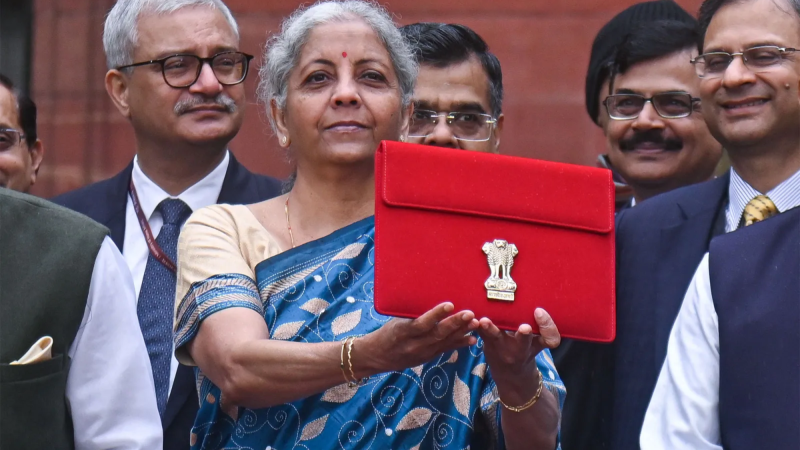
Finance Minister Nirmala Sitharaman
You're reading Entrepreneur India, an international franchise of Entrepreneur Media.
Finance Minister Nirmala Sitharaman on Sunday presented the Union Budget 2026 in Parliament. This marks her ninth consecutive budget presentation under Prime Minister Narendra Modi’s leadership. It is also the first time India’s Union Budget has been presented on a Sunday.
As expected, the budget speech focused on economic growth and sustaining and maintaining fiscal discipline. It also featured a slew of new reforms that focused on liberalization as well as transparency. It’s worth noting that the new budget comes amid a complex geopolitical situation. India recently signed an FTA with the EU, even as trade deal negotiations with the US are still ongoing.
Following the speech, the Sensex fell by 1,100 points, signaling disappointment among investors who were reportedly anticipating more tax relief.
Here are the key highlights of the Union Budget 2026 speech:
Key Fiscal Numbers
The Finance Minister highlighted important fiscal figures for the upcoming financial year 2026-27:
- Debt-to-GDP ratio: 55.6%
- Fiscal deficit: 4.3% of GDP
- Non-debt receipts: INR 36.5 lakh crore (Budget Estimate)
- Total expenditure: INR 53.5 lakh crore (Budget Estimate)
For the states, INR 1.4 lakh crore has been allocated under the 16th Finance Commission for 2026-27.
Infrastructure and Industrial Development
Sitharaman announced the establishment of a dedicated East Coast Industrial Corridor with an interconnected node at Durgapur to strengthen regional industrial development. She also proposed a special focus on the northeastern region with a scheme to develop Buddhist circuits across Arunachal Pradesh, Sikkim, Assam, Manipur, Mizoram, and Tripura.
In addition, she announced the creation of city-economic regions (CERs) with an allocation of INR 5,000 crore per CER over five years. Seven high-speed rail corridors have been proposed as growth collectors, connecting major cities such as Mumbai, Pune, Hyderabad, Bengaluru, Chennai, Delhi, Varanasi, and Siliguri.
To further modernise infrastructure, the budget proposes increasing Public Capital Expenditure to INR 12.2 lakh crore and setting up an Infrastructure Risk Guarantee Fund. New freight corridors from Dankuni to Surat, operationalization of 20 waterways over the next five years (starting with Odisha), and ship-repair ecosystems in Varanasi and Patna are planned.
Biopharma Shakti Initiative
The Finance Minister highlighted the significance of biologic medicines in improving life expectancy and quality of life at affordable costs. To boost India’s biopharma ecosystem and position the country as a global manufacturing hub, the budget proposes the Biopharma Shakti initiative with an outlay of INR 10,000 crore over five years.
The plan focuses on enhancing domestic production of biologics and biosimilars through a dedicated biopharma network. This includes the establishment of three new National Institutes of Pharmaceutical Education and Research (NIPERs), upgrading seven existing ones, setting up 1,000 accredited clinical trial sites, and strengthening the Central Drugs Standard Control Organisation to meet global regulatory standards.
Healthcare and Mental Health
On healthcare, the Finance Minister announced the setting up of NIMHANS 2.0, along with upgrading National Mental Health Institutes in Ranchi and Tezpur. These steps aim to improve mental healthcare and trauma care services across the country.
Agriculture and Rural Development
The budget proposed the launch of Bharat Vistar, a multilingual AI tool to integrate agricultural portals such as AgriStack and ICAR, helping farmers access AI-driven insights on agricultural practices. Sitharaman also proposed She-Marts, community-owned retail outlets within cluster-level federations, to boost local entrepreneurship.
Sports, Tourism, and Culture
To develop sports infrastructure, the Finance Minister proposed the Khelo India Mission, which will train coaches and organise competitions and leagues across the country.
In the tourism sector, the budget included several initiatives:
- Establishment of a National Institute of Hospitality by upgrading the existing council
- A pilot scheme to upskill 10,000 guides in 20 tourist spots
- A National Destination Digital Knowledge Grid for researchers, historians, and content creators
- Development of ecological trails in Himachal Pradesh, Uttarakhand, and Jammu & Kashmir, turtle trails in Kerala, Odisha, and Karnataka, and three bird-watching trails along Pulicat Lake
- Development of 15 archaeological sites
Education and Creative Industries
To promote creative education and design, the Finance Minister proposed support for the Indian Institute of Creative Technologies in Mumbai to set up AVGC content creator labs in 15,000 secondary schools and 500 colleges. A new National Institute of Design will also be established in Eastern India to strengthen design education and development.
Ease of Doing Business and Investments
Sitharaman announced that non-resident Indians will be allowed to invest directly in Indian listed companies through the Portfolio Investment Scheme (PIS). The individual investment limit will increase from 5% to 10%, and the total foreign investor cap will rise from 10% to 24%. These steps aim to attract long-term foreign investments, enhance shareholding, and deepen capital formation.
Textiles and MSMEs
The budget focuses on strengthening the textile sector through several initiatives:
- National Fiber Scheme to achieve self-reliance in natural, manmade, and new-age fibers
- Textile expansion and employment scheme
- National Handloom and Handicraft scheme
- Tex-Eco initiative
- Samarth 2.0
- Mega-textile parks in challenge mode
- Mahatma Gandhi Gram Swaraj Initiative to strengthen khadi, handloom, and handicrafts
For MSMEs, a three-pronged approach has been proposed: equity support through an INR 10,000 crore SME Growth Fund, topping up the Self-Reliant India Fund by INR 2,000 crore, and providing liquidity support via the TREDS platform. The government will also develop short-term courses for Corporate Mitras to support MSME growth.
Capital Goods and Manufacturing
To build capacity for strong capital goods, the Finance Minister proposed establishing high-tech toolrooms for manufacturing precision components at scale and lower costs. She also announced a scheme to enhance production of construction and infrastructure equipment (CIE) and a container manufacturing initiative with an allocation of INR 10,000 crore over five years.
Semiconductors and Technology
The budget allocated INR 40,000 crore for India Semiconductor Mission 2.0, building on the success of the first mission. The plan aims to strengthen semiconductor manufacturing, design, and Indian intellectual property, along with supporting research, training centers, and mineral-rich states including Odisha, Kerala, Andhra Pradesh, and Tamil Nadu.
Rare Earths and Chemical Parks
The Finance Minister announced dedicated rare earth corridors in Odisha, Kerala, Andhra Pradesh, and Tamil Nadu covering mining, processing, research, and manufacturing. Three chemical parks are proposed to boost domestic production and reduce import dependence.
Environmental Initiatives
The budget allocated INR 20,000 crore over five years for carbon capture, utilisation, and storage (CCUS) projects to address environmental sustainability.
Banking Reforms
A high-level committee on banking will review the sector comprehensively under the “Vikasit Bharat” initiative. The government also proposed restructuring Power Finance Corporation (PFC) and REC Limited to improve efficiency.
Six Pillars for Economic Growth
Finally, the Finance Minister outlined six key areas to accelerate economic growth:
- Scaling up manufacturing in seven strategic sectors
- Rejuvenating legacy industries
- Promoting champion MSMEs
- Boosting infrastructure development
- Ensuring economic stability
- Developing city-economic regions
In conclusion, Union Budget 2026 lays out a roadmap to strengthen India’s economic foundation through industrial development, infrastructure investment, digitalisation, healthcare, agriculture, sports, tourism, creative industries, and environmental sustainability. It aims to attract investment, boost domestic manufacturing, and enhance India’s global competitiveness while maintaining fiscal prudence.
Finance Minister Nirmala Sitharaman on Sunday presented the Union Budget 2026 in Parliament. This marks her ninth consecutive budget presentation under Prime Minister Narendra Modi’s leadership. It is also the first time India’s Union Budget has been presented on a Sunday.
As expected, the budget speech focused on economic growth and sustaining and maintaining fiscal discipline. It also featured a slew of new reforms that focused on liberalization as well as transparency. It’s worth noting that the new budget comes amid a complex geopolitical situation. India recently signed an FTA with the EU, even as trade deal negotiations with the US are still ongoing.
Following the speech, the Sensex fell by 1,100 points, signaling disappointment among investors who were reportedly anticipating more tax relief.

Entrepreneur Staff • Editor
Entrepreneur Staff
For more than 30 years, Entrepreneur has set the course for success for millions of... Read more