India’s IPO Rush: Are Companies Ready for the Public Market Spotlight?
India’s IPO boom is raising questions about company readiness, as investors increasingly scrutinise valuations, profitability, governance and the use of public funds.

Freepik
Opinions expressed by Entrepreneur contributors are their own.
You're reading Entrepreneur India, an international franchise of Entrepreneur Media.
The primary market in India is currently undergoing a considerable fundraising phase, having an active IPO calendar does not necessarily indicate significant profits for investors. The most recent trends suggest that businesses are increasingly open to being publicly traded, with investors becoming more discerning about the valuation process, earnings, corporate governance, and the intended use of the funds.
In terms of activity, the peak occurred in September-October 2026. Fortune India reports that September experienced the largest volume of IPO activities this year. This month, 34 companies went for IPOs on the main board of stock exchanges, raising Rs 39,380.13 crore in total. National Stock Exchange’s (NSE) IPO brought in as much as Rs 22,563 crore, or 57% of the total amount, while the other 33 ones, including Rentomojo, Moneyview, Hero Motors, Karamtara Engineering, Manipal Payment and Identity Solutions, and Varmora Granito, received Rs 16,817 crore.
The trend of fundraising picked up pace in October and although the tempo of IPOs dropped to 13, the sum raised reached a record-breaking level of Rs. 44,450.77 crore in October, thanks to the outstanding IPO of Jio Platforms and contributions made by other players such as Zetwerk Manufacturing and Bonfiglioli Transmissions. This increase comes after a period of time of good results achieved during the previous period of this quarter as well as in August when 23 businesses managed to collect Rs. 22,452.84 crore and in July when 12 companies earned Rs. 28,648.49 crore thus raising the overall amount for 2026 to Rs. 1.58 lakh crore.
Despite the good performance of the industry in fundraising, the principal issue is whether companies going public are ready for the criticism and additional responsibility conveyed in the process.
A busy market
This increase in fundraising has occurred at the time when the behaviour of investors has undergone significant transformation. Grant Thornton Bharat report, IPO Market Insights: Key Trends and SEBI-Driven Shifts in FY26, revealed that in total, 94 IPOs have taken place on the mainboard, bringing in Rs.1.602 lakh crore during the first nine months of FY26. Furthermore, it was noted that the average listing gain fell down to 9%, while it reached 29% in FY25.
The research also discovered that the average oversubscription reduced to 43 times, whereas in FY25, it amounted to 71 times. Although demand is still significant, investors start paying more attention to business quality and valuation of their investments before entering the market.
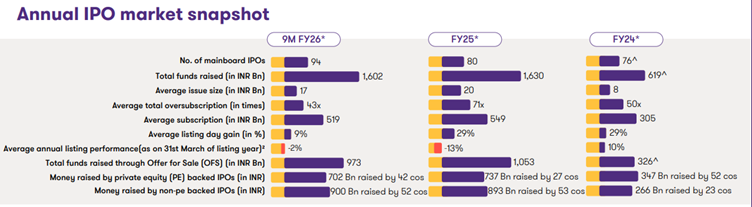
Karan Marwah, Partner and CFO Advisory Leader at Grant Thornton Bharat, points to this shift in investor expectations. “Average listing gains fell to 8% in FY26 from 30% a year earlier,” he said, reflecting a market that is becoming more selective.
According to Marwah, profitability is not necessarily a prerequisite for an IPO, particularly for companies investing in expansion. What matters is whether the business can demonstrate a credible path to profitability, healthy cash conversion and a clear explanation of how the funds will be deployed. Investors are also examining the balance between fresh issues and offers for sale (OFS), along with valuations and governance standards.
This distinction is important because an IPO can serve very different purposes. A fresh issue brings capital into the company to fund expansion, reduce debt, invest in capacity or strengthen working capital. An OFS, on the other hand, allows existing shareholders, including promoters and private equity investors, to sell their stakes.
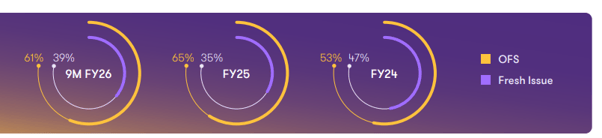
Grant Thornton Bharat’s analysis found that OFS accounted for approximately 61% of IPO proceeds in 9M FY26, while fresh issues contributed 39%. The NSE issue in September 2026 was also entirely an OFS, meaning the proceeds went to selling shareholders rather than the company.
A large OFS component is not automatically a concern. Early investors and promoters may have legitimate reasons to monetise their holdings. However, companies need to explain the rationale clearly, particularly when investors are being asked to pay a premium for future growth.
From growth stories to business fundamentals
The shift towards fundamentals is also changing which companies attract investor interest. According to several reports financial services, consumer services, capital goods, industrials, construction, healthcare and consumer durables among the active sectors in the IPO market.
Companies such as Moneyview and Manipal Payment & Identity Solutions represent the financial services and payments opportunity, while Hero Motors and Karamtara Engineering reflect investor interest in manufacturing and industrial businesses.
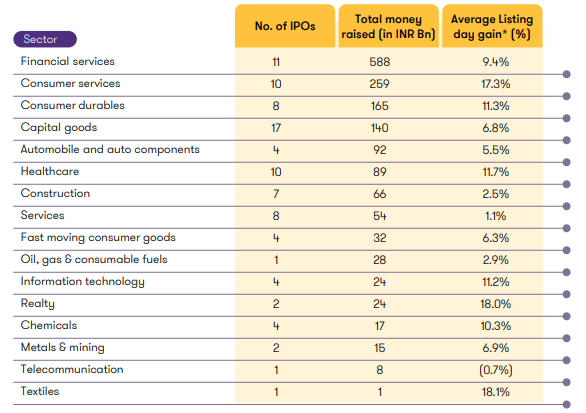
But sector momentum alone is not enough. Investors want to understand the economics of the business, its competitive position, revenue visibility and ability to generate sustainable cash flows. A compelling growth story must be supported by financial performance and a realistic valuation.
Sandeep Chordia, COO at Kotak Neo, believes that the quality of companies coming to the market will determine whether the IPO cycle creates lasting value. “Strong IPO markets are ultimately built on strong companies. Liquidity can influence timing, but sustainable value creation is driven by fundamentals, governance standards, and execution,” he said.
His point is particularly relevant as companies across different stages of maturity seek public capital. For startups, the transition involves demonstrating that rapid customer acquisition and revenue growth can translate into a sustainable business. For established promoter-led companies, the focus is often on professionalising management, improving disclosures and strengthening internal controls.
The real test after listing
India’s IPO market has proved its capability of attracting firms and raising funds. The fundraising initiatives in September, along with the broader pipeline of potential issuers highlight the heavy presence of the investors.
However, the drop in average listing gains indicates that the investors are not rewarding all IPOs just by virtue of being a part of a good market period. The companies need to demonstrate the need for public capital, how it will upgrade the business and what the shareholders can gain in the long term.
In terms of the issuers, the challenge is not only to get listed but also to build the company that will be in a position to substantiate its value long after the excitement of the listing day is over.
The primary market in India is currently undergoing a considerable fundraising phase, having an active IPO calendar does not necessarily indicate significant profits for investors. The most recent trends suggest that businesses are increasingly open to being publicly traded, with investors becoming more discerning about the valuation process, earnings, corporate governance, and the intended use of the funds.
In terms of activity, the peak occurred in September-October 2026. Fortune India reports that September experienced the largest volume of IPO activities this year. This month, 34 companies went for IPOs on the main board of stock exchanges, raising Rs 39,380.13 crore in total. National Stock Exchange’s (NSE) IPO brought in as much as Rs 22,563 crore, or 57% of the total amount, while the other 33 ones, including Rentomojo, Moneyview, Hero Motors, Karamtara Engineering, Manipal Payment and Identity Solutions, and Varmora Granito, received Rs 16,817 crore.
The trend of fundraising picked up pace in October and although the tempo of IPOs dropped to 13, the sum raised reached a record-breaking level of Rs. 44,450.77 crore in October, thanks to the outstanding IPO of Jio Platforms and contributions made by other players such as Zetwerk Manufacturing and Bonfiglioli Transmissions. This increase comes after a period of time of good results achieved during the previous period of this quarter as well as in August when 23 businesses managed to collect Rs. 22,452.84 crore and in July when 12 companies earned Rs. 28,648.49 crore thus raising the overall amount for 2026 to Rs. 1.58 lakh crore.