India PE-VC Investments Jump 46%, Led by Big-Ticket Deals
India’s investment boom reveals a shift towards larger deals, while startups and mid-market firms face changing investor expectations.

Freepik
Opinions expressed by Entrepreneur contributors are their own.
You're reading Entrepreneur India, an international franchise of Entrepreneur Media.
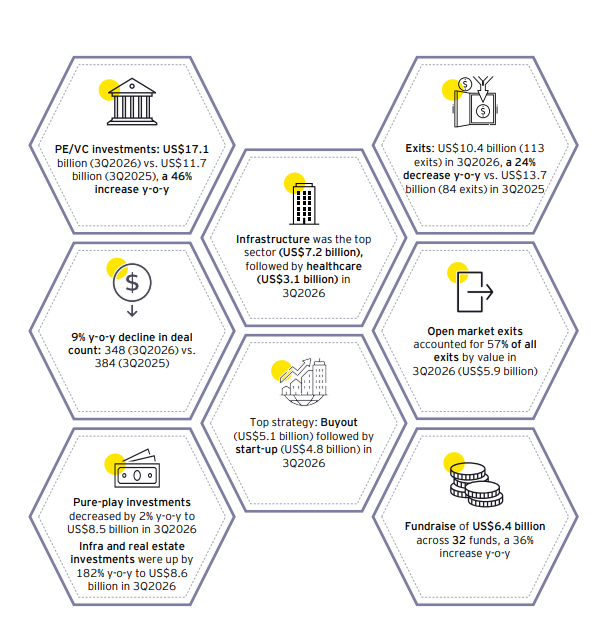
India’s private equity and venture capital (PE-VC) market recorded a strong rebound in the third quarter of 2026, with investments rising 46% year-on-year to US$17.1 billion. September alone attracted US$7 billion, making it the strongest month of the year so far.
However, beneath the headline growth, the investment landscape tells a more complicated story. While the value of investments increased sharply, the number of deals declined, indicating that capital is increasingly concentrated in fewer, larger transactions.
According to the latest investment data by EY-IVCA Monthly PE/VC Roundup, 348 deals were recorded in Q3 2026, compared with 369 in the corresponding quarter last year, representing a decline of approximately 6%. Despite fewer transactions, the average deal size increased from around US$32 million to US$49 million.
The trend suggests that investors are becoming more selective, committing larger amounts to established businesses and transactions with relatively clearer growth opportunities rather than spreading capital across a wider pool of companies.
Bigger Deals Are Driving Investment Growth
The growing concentration of capital becomes more evident when looking at transactions exceeding US$100 million.
During Q3 2026, India recorded 36 such deals, collectively valued at US$13 billion. These transactions accounted for approximately 76% of the quarter’s total investment value, compared with around 56% in the year-ago period.
At the other end of the spectrum, deals below US$100 million declined in both number and total value. This indicates that the increase in investment activity was not broad-based but was largely driven by a relatively small group of large transactions.
The shift also highlights a changing investment environment. Investors appear increasingly willing to deploy substantial capital into businesses with established operations, stronger market positions and the ability to absorb large investments.
For smaller companies and emerging businesses, however, securing funding could become more challenging as a larger share of available capital moves towards bigger transactions.
Real Estate and Infrastructure Lead
A closer look at sectoral investments reveals another important factor behind the 46% growth.
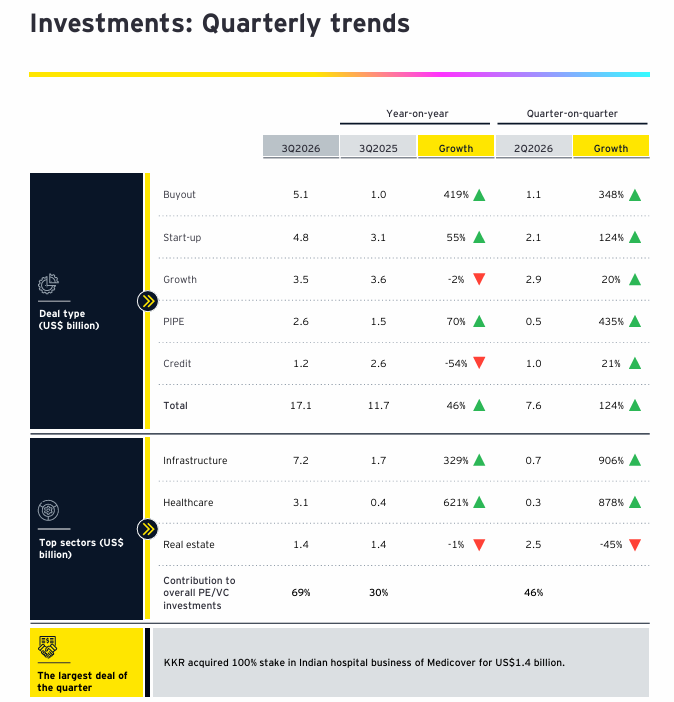
Real estate and infrastructure attracted US$8.6 billion during the quarter, registering a sharp 182% increase year-on-year. In comparison, investments in pure-play private equity and venture capital remained largely flat at US$8.5 billion.
This distinction is important because it suggests that the overall investment surge was driven primarily by real estate and infrastructure rather than a broad-based recovery across traditional PE-VC investments.
Large infrastructure requirements, long-term asset opportunities and the growing appetite for established businesses have made the segment an important destination for institutional capital.
In terms of deal structures, buyouts emerged as the leading investment category, attracting US$5.1 billion. One of the biggest transactions was KKR’s US$1.4 billion investment in Medicover India’s healthcare business, making it the largest deal of the quarter. Healthcare also remained an important investment theme, reflecting continued investor interest in businesses with long-term demand visibility.
Beyond infrastructure and healthcare, investors are also showing growing interest in capital-intensive sectors such as manufacturing, defence, aerospace and precision engineering.
Vijay Dhanuka, Managing Director and Co-Head (Private Equity) at Motilal Oswal Alternates, said this shift is being driven by the growing appetite for businesses that can absorb larger amounts of capital.
“Unlike in the earlier days, when a lot of interest was in consumer and financial services businesses, there is now renewed interest towards industrial manufacturing, defence, new-age businesses, alternate energy, battery storage and EVs,” Dhanuka said.
He attributed this shift partly to the returns generated by earlier investments in manufacturing companies, which have demonstrated the sector’s potential to create significant investor value.
A Strong Quarter
Despite the encouraging Q3 numbers, the broader investment picture calls for some caution.
The second quarter of 2026 was the weakest quarter in six years for PE-VC investments. Consequently, the latest growth figures also reflect a recovery from a relatively low base.
Moreover, cumulative investments during the first nine months of 2026 remained approximately 14% below the corresponding period last year.
This suggests that the third-quarter surge has not yet translated into a sustained recovery across the investment market. While large transactions have helped lift overall values, the decline in deal volumes indicates that investor participation remains uneven.
The difference between investment value and deal activity will therefore be an important indicator to watch in the coming quarters.
Startups Attract More Capital
The changing investment environment is also visible in India’s startup ecosystem.
Startup investments increased 55% year-on-year to US$4.8 billion during Q3 2026. However, growth-stage investments declined 2%, highlighting a divergence between early-stage funding momentum and capital availability for companies looking to scale.
The trend raises an important question about where capital is flowing within the startup ecosystem.
Krishna Jha, Managing Partner at Equirus InnovateX Fund, believes that capital availability is not the primary constraint for businesses with compelling propositions. However, investor expectations are changing, particularly as artificial intelligence reshapes the technology landscape.
“Businesses operating in conventional software and SaaS are facing greater scrutiny, as investors assess their long-term relevance and resilience in an AI-led economy. For mid-sized businesses, demonstrating a clear growth trajectory, differentiated capabilities and a credible strategy for technology adoption is becoming increasingly important,” Jha said.
He added that investor interest remains strong in artificial intelligence, deep tech, advanced manufacturing and robotics, where businesses with differentiated propositions continue to attract capital.
While investors continue to identify opportunities among emerging businesses, companies that have moved beyond the initial stages of growth may be facing greater scrutiny around profitability, valuations and their ability to generate sustainable returns.
At the same time, fundraising activity has reached record levels, suggesting that capital availability is not necessarily the primary constraint. The bigger question is how quickly fund managers are willing to deploy that capital and which businesses meet their investment expectations.
For mid-market companies, this could mean a more competitive fundraising environment. Businesses seeking larger growth cheques may have to demonstrate stronger financial performance, clearer profitability pathways and more predictable returns to attract investor interest.
The Bigger Picture
India’s PE-VC market is showing signs of renewed investment momentum, but the nature of that recovery matters as much as the headline numbers.
The 46% increase in quarterly investment value reflects the growing importance of large transactions, particularly in real estate, infrastructure, and buyouts. However, declining deal volumes and weaker growth-stage investments suggest that the benefits of this capital recovery are not being distributed evenly.
For founders and mid-market businesses, the next phase may be less about access to investment capital and more about meeting increasingly demanding investor expectations.
India’s private equity and venture capital (PE-VC) market recorded a strong rebound in the third quarter of 2026, with investments rising 46% year-on-year to US$17.1 billion. September alone attracted US$7 billion, making it the strongest month of the year so far.
However, beneath the headline growth, the investment landscape tells a more complicated story. While the value of investments increased sharply, the number of deals declined, indicating that capital is increasingly concentrated in fewer, larger transactions.
According to the latest investment data by EY-IVCA Monthly PE/VC Roundup, 348 deals were recorded in Q3 2026, compared with 369 in the corresponding quarter last year, representing a decline of approximately 6%. Despite fewer transactions, the average deal size increased from around US$32 million to US$49 million.