From Hype to Strategy, How Investors Are Navigating the AI Boom
Investors are shifting from AI hype to focused strategies, backing scalable startups, prioritising execution, managing costs, and betting on long term value across sectors as competition intensifies globally.
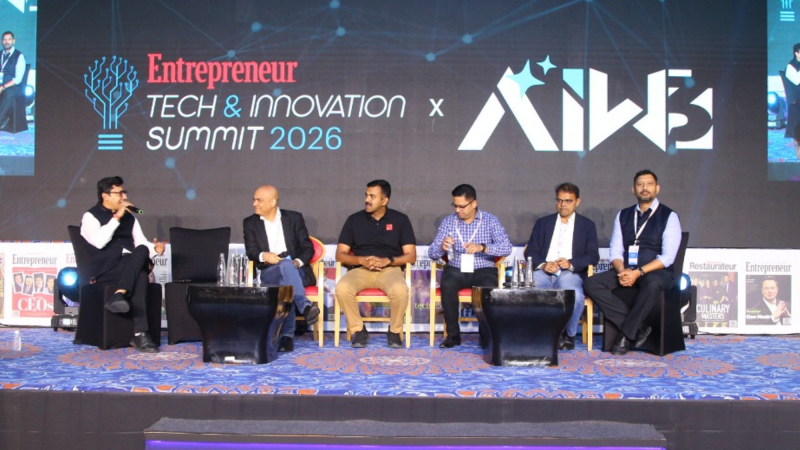
[L-R] Sachin Marya (Editorial Director, Entrepreneur India), Vikram Gupta (Founder and Managing Partner, IvyCap Ventures), Gowri Shankar (Partner, Antler India), Karthik Prabhakar (Managing Partner, Peer Capital), Saravanan Nattanmai (Partner, Premji Invest), & Ranjith Menon (Partner and Managing Director, Chiratae Ventures)
AI has moved beyond being just a speculative idea for investors. It’s quickly become a major force that influences how capital is distributed, how startups are created, and how entire industries transform.
Venture capital firms today are operating in an environment where innovation happens at lightning speed , competition is global from day one, and conviction is constantly tested. The real challenge isn’t just spotting the next big idea; it’s about supporting companies that can stay relevant in a world where change is the only constant.
At the Tech and Innovation Summit 2026 in Bengaluru, these themes were explored during a panel discussion titled “Investing in AI: Venture Capital Perspectives on the Next Wave.” Moderated by Sachin Marya (Editorial Director, Entrepreneur India) the session featured Vikram Gupta (Founder and Managing Partner, IvyCap Ventures), Gowri Shankar (Partner, Antler India), Karthik Prabhakar (Managing Partner, Peer Capital), Saravanan Nattanmai (Partner, Premji Invest), and Ranjith Menon (Partner and Managing Director, Chiratae Ventures), each bringing a distinct investment lens to the AI ecosystem.
Sachin Marya led the conversation to explore how investors are adapting in this fast-changing landscape, starting with the panelists’ strategies for investing in AI.
Vikram Gupta of IvyCap Ventures, outlined the firm’s broad strategy. “We invest across three themes. One is the India consumer and growth story. Second is deep tech and emerging tech where we invest in AI and similar opportunities. And the third is India for the world,” he said, highlighting the firm’s active participation across stages and sectors.
He also pointed to portfolio examples such as TurboHire and TraqCheck in HR tech, as well as Elucidata in drug discovery, to illustrate how AI is driving outcomes through continuous data learning.
Gowri Shankar from Antler India, emphasized the firm’s early stage focus. “We typically back founders pre product and pre revenue,” he said. “With respect to AI, we back companies across the stack, from model layer to infra layer to the application layer.” He cited Navana.ai, a voice AI platform enabling large scale loan disbursements for enterprises like Bajaj Finserv, as an example of how owning the full stack can create strong margins and defensibility.
Karthik Prabhakar (Peer Capital) noted, “We are a seed focused fund and within applied AI we only look at commerce, entertainment, finance, and healthcare.” He referenced Webless as a case study of how quickly AI businesses must evolve, while also acknowledging missed opportunities such as Emergent in the white coding space, which later emerged as a strong category.
Saravanan Nattanmai of Premji Invest, highlighted the firm’s evolving strategy. “We are seeing a lot of interesting opportunities to go early, particularly where tech led disruptions create significant value,” he said. He pointed to investments in AI driven insurance underwriting platforms and People Home, an AI native housing finance company, to demonstrate how AI is transforming traditional financial services workflows.
Ranjith Menon from Chiratae Ventures, reinforced AI’s growing share in venture portfolios. “We expect about 30 to 40 percent of our capital going into AI,” he said. He referenced Pixis, an AI driven marketing platform with strong enterprise adoption, as well as TakeMe2Space, a forward looking bet on space based data centers, reflecting how AI demand is influencing even infrastructure investments.
As the conversation unfolded, the panel explored the ways in which AI has transformed the way we think about investments. Menon reflected on a missed opportunity that altered his perspective. “This whole white coding piece seemed like something large models could do themselves, but it has become a category by itself,” he said, referencing companies like Emergent that unlocked new demand by simplifying development processes.
Nattanmai pointed to AI’s transformative role within traditional sectors. “In the last 12 to 18 months, I have seen how AI vendors are accelerating the journey for portfolio companies,” he said, particularly in areas like insurance where underwriting workflows are being reimagined.
Prabhakar emphasised the speed at which assumptions can change. “The thesis with which we invested started playing out within six months, but very quickly we realised it was not sustainable,” he said, reflecting on Webless and the need for constant product evolution.
Shankar spoke about building defensibility in a crowded market. Referring again to Navana.ai, he said, “They own the full stack, from speech recognition models to deployment. This gives them SaaS type margins which is not possible if you operate only at the application layer.” He added, “Your imagination is the limit on how you can build a defensible business.”
Gupta highlighted the importance of data driven outcomes through examples like TurboHire, TraqCheck, and Elucidata. “It was more outcomes driven and the model itself was learning based on the more data that they were generating,” he said, explaining how sustained data accumulation strengthens AI systems over time.
The panel also addressed the gap between perception and execution in AI startups. Menon noted that many companies still operate with significant human intervention before achieving full automation, citing internal examples from healthcare insurance management platforms transitioning toward AI driven workflows.
Execution beyond technology emerged as a recurring theme. Gupta highlighted Miko, a consumer robotics company, as an example where distribution played a crucial role. “It is not just about the product. Distribution plays a very important role, especially when entering global markets,” he said, referring to its presence in retail chains like Walmart and Costco in the US.
Shankar discussed the inevitability of pivots, sharing examples of startups that moved from AI based creative tools to building foundational reasoning models, and others that shifted from e-commerce dispute resolution to enterprise solutions like SAP application management services.
Cost dynamics remain a pressing concern. Prabhakar noted, “Compute and infra cost is roughly around 40 percent of overall burn for some companies,” highlighting ongoing challenges in building sustainable AI businesses despite strong demand.
On regulatory considerations, “If we do this well within regulatory frameworks, it will be disruptive, but the if is very big,” Nattanmai said, particularly in financial services where companies like People Home are pushing boundaries within compliance frameworks.
Audience questions brought forward practical insights into investment decision making. Shankar shared, “We over index on the founder, their ambition, vision, and speed.” Prabhakar added, “At a seed stage, it comes down to the team and market, and whether it can generate fund level returns.”
Looking ahead, the panelists converged on the inevitability of AI integration across industries. Nattanmai observed, “In eight to ten years, there may not be a single company where AI is not deeply integrated.”
In closing reflections, Gupta said, “It is about the problem you are solving, not the solution.” Shankar pointed to the need for faster decision making in an AI driven world, while Prabhakar emphasised continuous learning as a critical capability for investors. Nattanmai highlighted the importance of self disruption, stating, “If we fail to disrupt ourselves, someone else will.”
Menon concluded with a grounded perspective. “It is important to build something that creates real value for the customer and not just focus on the technology itself.”
The discussion underscored a clear takeaway. While AI continues to evolve at an unprecedented pace, real value is being created by companies that combine strong problem solving with execution, adaptability, and the ability to scale across markets.