Ola Electric Eyes QIP Funding As Revenue Drops Over 56% in Q4 FY26
Weak sales and cash burn cause Ola Electric’s revenue to drop more than 56% year-on-year in Q4 FY26.

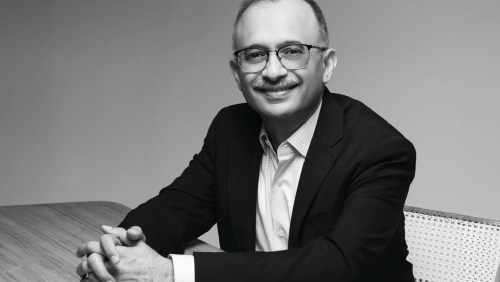
Bhavish Aggarwal
Opinions expressed by Entrepreneur contributors are their own.
You're reading Entrepreneur India, an international franchise of Entrepreneur Media.
Ola Electric is seeking additional funds through a proposed qualified institutional placement (QIP) as it looks to solve a plausible liquidity crisis.
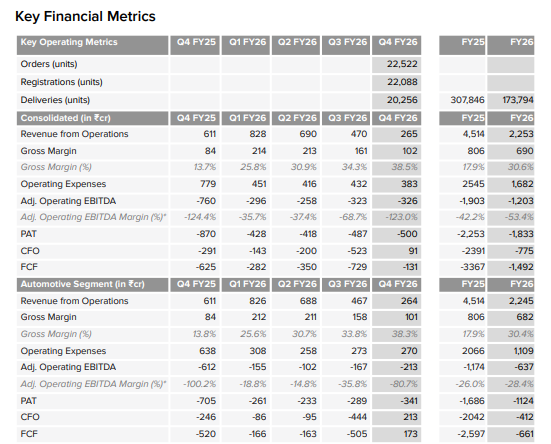
On Wednesday, the Bhavish Aggarwal-led EV firm reported its earnings for the Q4 2026 revealing a massive 56% year-on-year revenue drop. In Q4 26, its operating revenue stood at INR 265 crore, down from the INR 611 crore in the same quarter last year.
Consolidated losses improved from INR 870 crore to INR 500 crore in the said quarter, though. It’s primarily because operating expenses have gone down from INR 779 crore in Q4 2025 to INR 383 crore in Q4 2026.
Sequentially, Ola Electric’s losses surged 2.7% from INR 487 crore in the quarter ending December 2025 whereas revenue saw a drop over 40%. Segment wise, automotive continues to drive the majority of revenue at INR 264 crore whereas the Cell segment contributed just INR 4 crore.
The decline in revenue and sales seemed to have nudged the company to explore additional funding opportunities.
In a filing it noted that the group’s cash flow amounting to INR 775 crore (Year ended March 31, 2025; INR 2,391 crore) from operations during the year ended March 31, 2026 “is primarily on account of continued operating losses and lower than expected growth in sales volume, which requires the Group to consider mitigating circumstances, in order to support its operations and meet its continuing obligations.”
“Accordingly, the Group’s management has carried out an assessment of its going concern assumption and believes that the Group will be able to continue to operate as a going concern for the foreseeable future and meet all its liabilities as they fall due for payment. To arrive at such judgement, management has considered a) available cash and bank balances; b) expected future operating cash flows of its material subsidiaries based on its business projections from expansion of its business operations, increase in gross margins, launch of new products, and expected operational efficiencies; c) available credit limits; and d) ongoing discussions with investors/lenders to secure additional funding from institutional investors,” the filing added.
Rubina Singla, Founder of Equitrust, tells Entrepreneur India that Ola Electric revenue is dropping primarily because of drop in sales volume with intense competition coming from TVS motor, bajaj and Ather as the product and service is better than Ola electric.
It’s worth noting that Ola Electric’s rival Ather Energy reported a better in Q4 FY26 with its operating revenue rising 74% year-on-year. The company also shrunk its losses by 57%. During the quarter, it sold around 79,251 vehicles, significantly higher than 20,256 units delivered by Ola Electric in the same period.
“Many complaints have also come regarding services which has also affected the consumer confidence in Ola. Also overall the sale in the EV segment is not rocketed as expected with the push given in this sector,” according to Singla.
Founder Aggarwal in an earnings call, however, said that customers have continued to show interest in the brand. He also noted that some of the videos doing the rounds on social media are old and that they keep reappearing online due to competitive pressures.
On issues relating to services, the founder added that the delays happened partly because of a weak supply chain though it has now expanded its network. “So earlier we were not stocking any parts in our service center. “Even for a brake pad replacement the guy had to wait 10 days.” Aggarwal is quoted as saying.
Even as Q4 was a low volume quarter, Ola has some optimism: it says its “gross margin reached 38.5%, opex reduced materially through the year, cash burn reduced significantly, service stabilised, and sales recovery began, while cell moved from the validation phase to scale. This is the milestone we had set for ourselves in the current quarter and we have delivered the promise.”
“In auto, service was the most important operating focus. Service has now materially stabilised. Average TAT reduced, parts availability improved, technician productivity increased and repair capability strengthened. Gen 3 is also reducing service demand at the product level. As service improved, we have experienced a V-shaped sales recovery from Q4, with April registrations up 20% month-on-month even as the broader E2W industry declined by more than 22%. This improvement is also visible in our P&L: warranty cost in the current year stands at INR59 crore, compared with INR 555 crore in FY25,” it added.
The key focus areas for the coming fiscal year are sustain service consistency, scale volumes with discipline, improve auto cash generation, ramp the Gigafactory, and build the storage business.
Cash generation, however, seems a bit complex challenge as of now. The QIP could be the olive branch as Singla explains: “With QIP comes fresh money in the company which can be utilised in increasing production, quality control and upgrading service facilities. It increases the confidence of retail investors. The company can increase its profitability with the funds raised under QIP.”
It’s worth noting that Ola had already reallocated a portion of its IPO proceeds. According to a filing, INR 475 crore of INR 575 crore was reallocated to repay debt.
Dev Chandrasekhar, Partner at Transcendum, tells Entrepreneur India that Ola Electric’s FY26 financial performance reflects a company in transition — trading revenue growth for profitability and cash conservation.
“While the gross margin improvement from 17.9% to 30.6% demonstrates successful cost optimization, the 50% revenue decline raises questions about the sustainability of the recovery. The Q4 FY26 operating cash flow positive result is a positive milestone, but the company still requires external funding to meet debt obligations and fund gigafactory expansion. The QIP addresses immediate liquidity needs but comes with significant dilution concerns given the ongoing losses and uncertain revenue trajectory,” he added.
Ola Electric is seeking additional funds through a proposed qualified institutional placement (QIP) as it looks to solve a plausible liquidity crisis.
On Wednesday, the Bhavish Aggarwal-led EV firm reported its earnings for the Q4 2026 revealing a massive 56% year-on-year revenue drop. In Q4 26, its operating revenue stood at INR 265 crore, down from the INR 611 crore in the same quarter last year.
Consolidated losses improved from INR 870 crore to INR 500 crore in the said quarter, though. It’s primarily because operating expenses have gone down from INR 779 crore in Q4 2025 to INR 383 crore in Q4 2026.