Inside India’s Deep-Tech Race: The Capital, Policy and Scale Challenge
How government funding and private capital are shaping India’s deep-tech ecosystem and ambitions to build global technology leaders.

Freepik
Opinions expressed by Entrepreneur contributors are their own.
You're reading Entrepreneur India, an international franchise of Entrepreneur Media.
India’s deep-tech ecosystem is at a crucial stage, with governments, financial institutions and private investors increasingly focusing on building indigenous capabilities in emerging technologies.
Bengaluru is positioning itself as a key deep-tech hub, backed by Karnataka’s Deep Tech Decade initiative, funding programmes and a growing network of research institutions, incubators and venture capital firms. Recently, at the stage IVCA circle session, Mr. Priyank Kharge, Minister for Home Affairs, Information Technology, Biotechnology, and E-Governance, mentioned, “We are building to become the next deep tech city not just for India but for the globe, and the government is ready to become your first client.”
Bengaluru has emerged as India’s deep tech gateway through its paramount concentration of research institutions, corporate R&D labs, and specialized campuses to anchor frontier technology. The dense R&D and institutional anchors like IISc and ISRO foster tight collaboration between academic researchers, multinational engineering teams, and deep-tech founders. The technology roadmaps, like India’s first specialized innovation campus, integrated advanced R&D zones, corporate innovation labs, and startup accelerators focused on climate tech, space tech, quantum, and AI, have set up a strong path for innovators.
In addition to that, the Karnataka startup policy makes it an attractive destination for startups.
The policy commits over Rs.518–570 crore in direct ecosystem support, supplemented by a Rs.500 crore Fund of Funds and a Rs.100 crore KITVEN (Karnataka Information Technology Venture Capital) fund to provide patient capital for high-risk ventures.
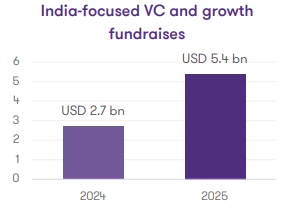
In 2026, India’s deeptech ecosystem has moved beyond research capability; the recognised startup base crossed 250,000 in October 2026, with more than half of it beyond the metros. Investors are willing to back technically ambitious companies, but they increasingly expect founders to demonstrate how each financing round reduces a specific set of risks. With this, Domestic venture fundraising doubled to USD 5.4 billion in 2025 reported by IVCA.
As the market becomes more selective, seed funding was down 37% in the first nine months of 2026. Deeptech is different from consumer tech; funding decisions rely on technical validation and milestone gating. Public funds and institutional investors segment capital by Technology Readiness Level (TRL).
Private investors look closely at whether founding teams possess deep domain expertise alongside a realistic roadmap for navigating capital-intensive manufacturing or regulatory hurdles. Coming to sector-specific capital deployment, it has shifted from pure software to strategic hardware-heavy domains like Semiconductors, robotics and Advanced Materials and Strategic Technologies.
In April 2026, the government notified Startup India Fund of Funds 2.0 with a Rs.10,000 crore corpus. The programme will make commitments to eligible Alternative Investment Funds, with Deeptech, technology-driven innovative manufacturing and early-growth companies among the priority segments. The most important development is the operationalization of the Rs.1 lakh crore Research, Development and Innovation (RDI) Fund under the Anusandhan National Research Foundation. By July 2026, the Technology Development Board had approved 22 projects with a combined project cost of Rs.4,744 crore, including Rs.2,192 crore of RDI Fund support.
Private equity and venture capital interest in Indian deep tech is scaling up. According to the IVCA Bharat DeepTech Report 2026, cumulative PE-VC investments in the sector reached roughly USD11.4 billion since 2015. Deep-tech funding has accelerated sharply. In Q3 2026, Indian deep-tech startups raised USD290 million across 28 deals, marking a 176% year-over-year increase compared to USD105 million in Q3 2025, significantly outpacing the broader startup ecosystem’s 5% growth.
“E-commerce and consumer tech defined the first wave of Indian venture capital, backed largely by domestic early-stage money. To fuel the next wave in Deeptech, we have to rethink capital—leveraging Fund-of-Funds, patient domestic pools, and stronger exit pathways through domestic M&A so founders aren’t solely reliant on the less than 10% of VC bets that reach an IPO.” TC Meenakshisundaram Founder and Vice Chairman, Chiratae Ventures said.
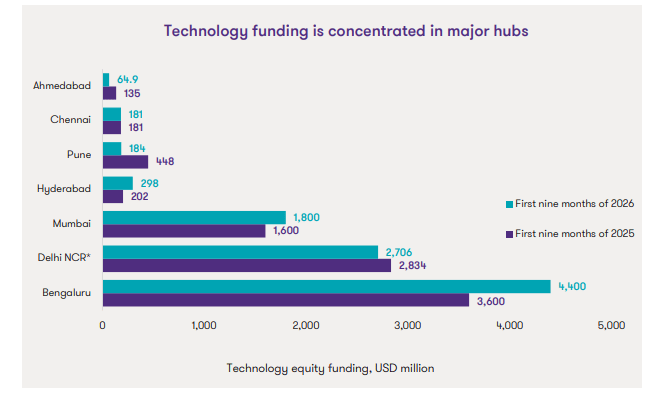
India’s deep-tech ecosystem is rapidly growing through strong institutional backing, targeted policy support, and growing private capital. The nation is moving beyond pure software into strategic hardware domains like semiconductors, robotics, and advanced materials.
While private investors have become more selective and focused on technical validation, major public initiatives like the Startup India Fund of Funds and the national RDI Fund are stepping in to provide patient capital, laying the groundwork for Indian startups to scale manufacturing and compete globally.
India’s deep-tech ecosystem is at a crucial stage, with governments, financial institutions and private investors increasingly focusing on building indigenous capabilities in emerging technologies.
Bengaluru is positioning itself as a key deep-tech hub, backed by Karnataka’s Deep Tech Decade initiative, funding programmes and a growing network of research institutions, incubators and venture capital firms. Recently, at the stage IVCA circle session, Mr. Priyank Kharge, Minister for Home Affairs, Information Technology, Biotechnology, and E-Governance, mentioned, “We are building to become the next deep tech city not just for India but for the globe, and the government is ready to become your first client.”
Bengaluru has emerged as India’s deep tech gateway through its paramount concentration of research institutions, corporate R&D labs, and specialized campuses to anchor frontier technology. The dense R&D and institutional anchors like IISc and ISRO foster tight collaboration between academic researchers, multinational engineering teams, and deep-tech founders. The technology roadmaps, like India’s first specialized innovation campus, integrated advanced R&D zones, corporate innovation labs, and startup accelerators focused on climate tech, space tech, quantum, and AI, have set up a strong path for innovators.