India Investment Forum 2026: Private Markets vs Public Markets: Where is Capital Really Going?
India’s private markets are maturing as domestic capital rises, valuations turn disciplined, and IPO readiness takes center stage.
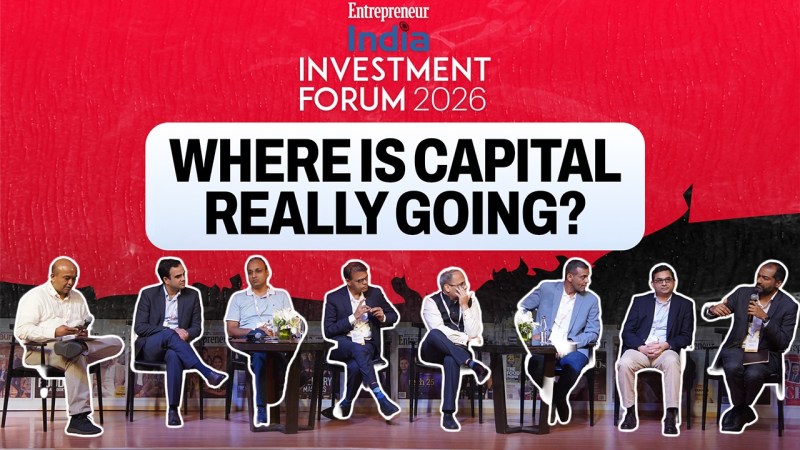
India Investment Forum 2026
You're reading Entrepreneur India, an international franchise of Entrepreneur Media.
India’s investment ecosystem is undergoing a transformation as domestic capital emerges as a significant player. At the Entrepreneur India Investment Forum 2026, Anurag Agrawal, Partner, Aavishkaar Capital, revealed that while nearly 90-95 percent of his firm’s first funds were raised from global investors, almost half of the capital for his latest fund came from domestic sources.
The conversation revolved around private market discipline, valuation sanity, and IPO readiness as India’s investment ecosystem matures.
Unni opened the conversation around private vs public market valuation sanity by observing that private market investors have a long-term view and are less susceptible to market volatility.
“There is a 15-year view of life,” said Unni. “In a 15-year view, valuations come back to the mean.” He further added that the correction in public market valuation creates opportunities in the private market where investors can take a contrarian view rather than paying prices set in the public markets.
“I believe earnings growth and return on equity matter, and I believe that those are the same metrics that should drive decision-making in the private market,” said Jafar. He further observed that while investors may have gotten excited about revenues, it is ultimately earnings that matter when it comes to realizing exit value. On the other hand, Abhishek, Yadav, MD, Quadria Capital spoke about the evolution of public market investors, who have become much more disciplined over the last couple of years.
“As far as the listed market is concerned, people have become very rational. They want to see consistency in earnings. So, it is not necessarily about higher earnings growth, it is about predictability of earnings,” said Abhishek.
Another important theme that emerged from the discussion was the changing nature of capital in India. Navin Honagudi, Managing Partner, Elev8 Venture Partners spoke about the evolution of family offices in India which has led to a paradigm shift in the funding landscape. Indian capital is now being directed towards funding startups on a much larger scale.
The panelists also noted that while foreign investors are evaluating opportunities in India through the lens of depreciation and macroeconomic headwinds, domestic investors have a deeper understanding of local market fundamentals.
“As long as we continue to see domestic capital as the backbone of our ecosystem, it is going to help us cushion through some of these macroeconomic headwinds,” said Saravanan. He further observed that domestic ownership is more important in certain sectors such as financial services, healthcare, defense, robotics, and space.
Agrawal further elaborated that Aavishkaar capital has seen a paradigm shift in terms of fundraising as almost half of the capital for their latest fund has come from domestic sources compared to nearly 90-95 percent of foreign investors for their first funds. “Domestic investors are also more connected to the ground reality, and we are seeing more co-investments from them,” he added.
Speaking about the importance of domestic debt, Ashish Gala, Co-founder and Managing Partner, Venture Soul Partners observed that domestic and foreign capital are both important players in the ecosystem.
“Debt investors, in my view, both domestic and international, play a very important role in the capital structure of any private market company. However, while domestic investors give the first cheque, the second and third cheques are bigger and usually come from international lenders,” he said.
On the topic of if and when the private market has become more disciplined and less euphoric, the panelists noted that while valuation euphoria is still present in certain sectors, the overall environment has changed since the funding boom of 2021. According to Abhishek, the private market has always been disciplined, but it is important to evaluate opportunities on a case-by-case basis.
“The valuations of the private market have always been very dependent on the quality of the company. I don’t think you can look at one-size-fits-all valuation,” he said. Jafar added that the last five years have been a rollercoaster as the private market space went from mania to a winter and is now on the path to recovery. “I think we are much more grounded now. There is no question about it. The froth has gone away; some froth will always remain, but I think we are much more disciplined as investors today than we were five years ago,” he added.
The final question centered on the idea of when founders should consider listing their companies. On the topic of going public, Unni felt that founders should not get seduced by the frenzy around IPOs and should think about listing only when their companies are ready to operate according to higher standards of governance as well as deliver on earnings potential on a quarterly basis.
“The public market is super unforgiving. The quarterly cycle is relentless,” he said. Saravanan added that businesses need to be boring and predictable before considering an IPO. “To me, the objective of going public should be to create value for public shareholders. That requires a certain degree of predictability of outcomes and processes and governance,” he said.
On M&A as an alternative to an IPO, Saravanan said that founders should consider building large pools of capital before going public as it would help them create better valuations in the public market. The discussion also underlined the importance of creating sustainable value for business owners.
Whether it was private vs public market or domestic vs foreign capital, the message was about disciplined capital allocation. With India’s capital markets evolving and more domestic institutional investors coming on board, India’s private markets are entering a new phase as investors become more value conscious and less susceptible to valuation euphoria.
India’s investment ecosystem is undergoing a transformation as domestic capital emerges as a significant player. At the Entrepreneur India Investment Forum 2026, Anurag Agrawal, Partner, Aavishkaar Capital, revealed that while nearly 90-95 percent of his firm’s first funds were raised from global investors, almost half of the capital for his latest fund came from domestic sources.
The conversation revolved around private market discipline, valuation sanity, and IPO readiness as India’s investment ecosystem matures.
Unni opened the conversation around private vs public market valuation sanity by observing that private market investors have a long-term view and are less susceptible to market volatility.

Entrepreneur Staff • Editor
Entrepreneur Staff
For more than 30 years, Entrepreneur has set the course for success for millions of... Read more