India Investment Forum 2026: AI & the Real Economy: Hype vs Deployment
AI in corporate India has moved beyond experimentation to solving real business problems. Leaders across finance, media, enterprise tech.
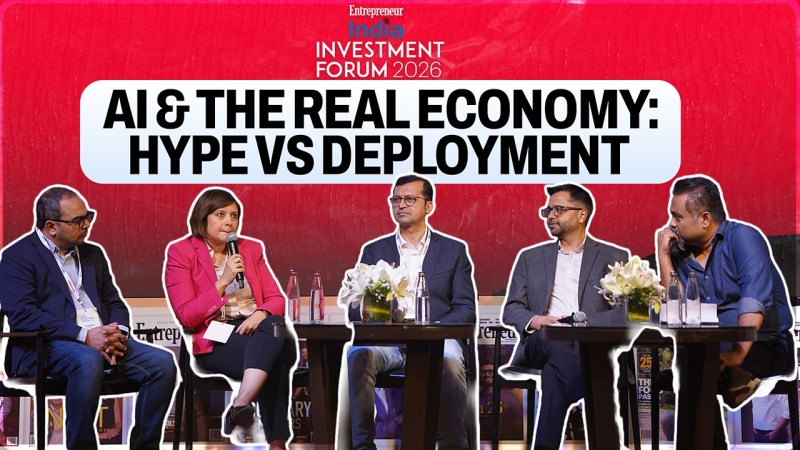
India Investment Forum 2026
You're reading Entrepreneur India, an international franchise of Entrepreneur Media.
Across finance, media, enterprise tech and venture capital, AI is being utilized to solve real-world problems, drive productivity and create new economic opportunities, as opposed to being used for content generation or image creation.
In an opening remark, Dipankar stated that while people are talking about ChatGPT, companies are continuing to use machine learning, computer vision, and data science to operate their businesses. The panelists noted that while generative AI has pushed things, it was critical to think about what technology to apply to a particular business problem.
“The use cases of AI were limited to experimentation before, but now, we are actually looking at enterprise-level applications. Our organization is looking at ways to democratize finance through AI,” said Siddharth, Chief AI Officer, Motilal Oswal. He added that the company is looking at ways to enable more retail investors to benefit from investment research, which currently are in long pdf reports. Using AI, investors can now get summarized research in chatbots, audio, video, and natural language, which can be consumed in multiple languages.
However, He mentioned that it is critical to evaluate risk versus reward when deploying AI. For example, while marketing and engagement could be automated using AI, high-touch advisory services required human intervention.
“At Eros, we’ve actually been using AI for the last 15 years, with recommendation engines and predictive analytics. But generative AI has dramatically cut down timelines for execution,” said Vikram, CEO, Eros universe & Eros Now, Eros Innovation. He added that the biggest difference with generative AI was that people could rapidly prototype products. In other words, they could take an idea from paper to production much faster than before. However, people need to think about how AI could complement human creativity, as opposed to replacing it.
Vikram further added that Eros was looking at ways to take AI beyond their organizations and enable fans to create content using characters from movies owned by Eros. For example, they could use their existing 11,000 plus movies and invest in large cultural models to develop “proprietary” models based on their content, scripts, and music as opposed to using publicly available data. This would enable them to create new revenue streams while also protecting their IP. In essence, they are looking at ways to leverage AI to build “ethical” business models.
“The conversation around AI in corporate India has shifted from ‘whether’ to ‘how’ we could leverage it to derive tangible business benefits. With over 450 enterprise clients, we’ve seen a massive reduction in timelines, with companies rapidly deploying AI for decision-making. However, I’ve noticed that with AI, there is a need for high-quality data, without which even the best algorithms fail,” said Rakhi, Co-founder, ClarityX and Non-executive director, C E Info Systems (MapmyIndia Mappls). Her company focuses on developing enterprise AI solutions across multiple industries.
Rakhi added that with natural language processing, small-time players and businesses in Tier 3, 4, and rural areas could get meaningful insights about the local market, which previously was only possible for big players. Siddharth added that multilingual AI models could enable such businesses to offer products and services to customers, including first-time investors from small towns and cities in their preferred language.
“I don’t think AI is another technology discontinuity, like the internet. It’s a whole different game. I think domain-specific AI with unique data, not just me-too applications on large language models, will actually differentiate companies in segments like healthcare, defense, or edge AI, or even automation,” said Chetan, Founding Partner, Aum Ventures. He noted that AI-enabled tools and apps across specific sectors would see adoption and benefit from large-scale capitalization, including on the funding front.
The discussion concluded by noting that corporate India was out to make AI ‘enterprise-ready’. In other words, the focus was on solving tangible business problems, with human intelligence playing a critical role in deploying these systems, as opposed to blindly adopting them as a ‘technology’. It is critical to combine human expertise and intelligence with technology to develop “reliable” AI systems.
In addition, India needs to rapidly develop proprietary data and leverage it to build business models around AI. With generative AI being disruptive and a multiplier, the competition for talent and data is expected to heat up. The winner-takes-all scenario makes it critical for companies to embrace AI as opposed to being ‘disrupted’ by it.
Across finance, media, enterprise tech and venture capital, AI is being utilized to solve real-world problems, drive productivity and create new economic opportunities, as opposed to being used for content generation or image creation.
In an opening remark, Dipankar stated that while people are talking about ChatGPT, companies are continuing to use machine learning, computer vision, and data science to operate their businesses. The panelists noted that while generative AI has pushed things, it was critical to think about what technology to apply to a particular business problem.
“The use cases of AI were limited to experimentation before, but now, we are actually looking at enterprise-level applications. Our organization is looking at ways to democratize finance through AI,” said Siddharth, Chief AI Officer, Motilal Oswal. He added that the company is looking at ways to enable more retail investors to benefit from investment research, which currently are in long pdf reports. Using AI, investors can now get summarized research in chatbots, audio, video, and natural language, which can be consumed in multiple languages.

Entrepreneur Staff • Editor
Entrepreneur Staff
For more than 30 years, Entrepreneur has set the course for success for millions of... Read more