Dell Rolls Out Integrated Solutions to Tackle AI, Security and Scalability Challenges
New storage, compute, cyber resilience and automation innovations deliver a foundation built for modern and traditional workloads
AI
You're reading Entrepreneur India, an international franchise of Entrepreneur Media.
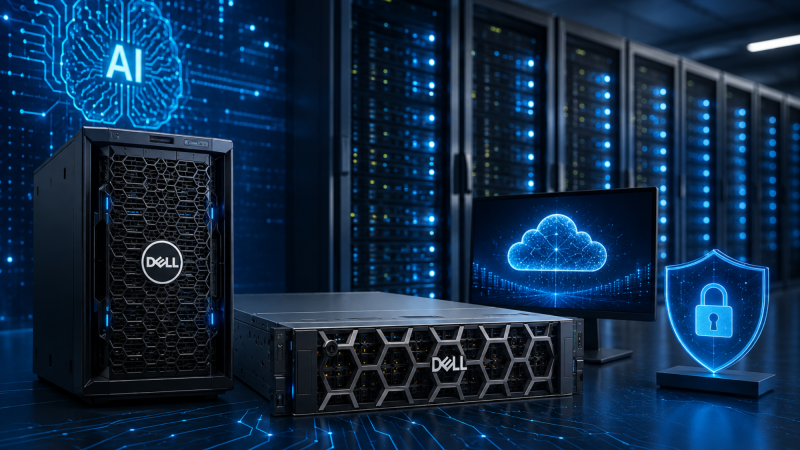
Dell Technologies has introduced a new set of infrastructure solutions aimed at reshaping how modern data centers operate in the age of AI. The announcement includes upgrades across storage, compute, cyber resilience and automation, as enterprises face growing pressure to support both traditional workloads and rapidly scaling AI applications.
The company’s latest offerings are designed to address a key challenge for businesses: managing current operations while preparing for future demands. As AI adoption accelerates, many existing data centers struggle to keep up with performance, scalability and security requirements.
A central highlight is the launch of Dell PowerStore Elite, a new enterprise storage platform. The system combines AI-driven software with updated hardware to deliver up to three times better performance than previous versions. It also offers high storage density, with capacity reaching up to 5.8 petabytes in a compact form factor. Dell said the platform supports non-disruptive upgrades, allowing organisations to modernise without downtime or data migration, while maintaining modular and upgradeable components.
In the compute segment, Dell has expanded its PowerEdge server portfolio with eleven new systems. These servers are designed to improve efficiency across both air-cooled and liquid-cooled environments. The latest generation delivers significant performance gains and enables higher consolidation, allowing organizations to run more workloads on fewer machines.
Some of the new servers are tailored for demanding AI and high-performance computing tasks, including liquid-cooled models that can handle dense processing requirements. Other systems focus on flexibility and scalability, supporting advanced graphics processing units and high core counts. Dell has also introduced space-efficient models aimed at reducing power consumption, cooling needs and licensing costs.
Cybersecurity remains another major focus area. Dell introduced PowerProtect One, a platform that integrates data protection, threat detection and recovery into a unified system. It is designed to simplify operations by reducing the need for multiple tools while improving visibility across environments. The company claims the platform can cut management overhead significantly while maintaining strong data protection capabilities.
Additionally, Dell Cyber Detect has been extended to its enterprise storage systems. The tool uses AI to identify ransomware and other threats by analyzing data patterns at a granular level. With high detection accuracy, it can help organizations locate the last clean version of their data, enabling faster recovery after an attack.
The company is also expanding its private cloud offerings. Dell Private Cloud now allows businesses to deploy software from multiple providers, including Broadcom, Microsoft and Nutanix, on a unified infrastructure. This approach is intended to give organisations more flexibility while avoiding dependency on a single vendor. It also supports independent scaling of compute and storage resources, potentially reducing costs.
For distributed environments, Dell has enhanced its edge-focused solutions under the Distributed Private Cloud framework. These systems are designed to maintain resilience and operational continuity across remote locations, with features such as automatic failover and built-in security.
Automation is another key pillar of the announcement. Dell introduced the Automation Platform, which uses AI-driven tools to simplify infrastructure management. The platform includes a conversational interface and intelligent agents that can monitor systems, analyse data and recommend actions. This aims to reduce manual effort and improve efficiency in IT operations.
Complementing this is Dell Automation Studio, a tool that allows organisations to build customized automation workflows across their infrastructure and applications. It is designed to integrate with existing tools and processes, helping teams streamline deployment and management tasks.
Industry analysts note that enterprises are under increasing pressure to handle complex IT demands without expanding their workforce. Solutions that reduce operational complexity and automate routine processes are becoming essential. Dell’s integrated approach, combining storage, compute, security and automation, is intended to address these challenges in a unified manner.
The new products and services will be rolled out in phases. PowerStore Elite is expected to be available in mid-2026, while several PowerEdge servers will launch later in the year and into 2027. PowerProtect One is already available, and additional cybersecurity and cloud capabilities are scheduled for release over the coming months.
As enterprises continue to modernise their IT environments, the focus is shifting toward systems that can handle both current needs and future growth. Dell’s latest portfolio reflects this transition, with an emphasis on flexibility, performance and integrated management across the data center.
Dell Technologies has introduced a new set of infrastructure solutions aimed at reshaping how modern data centers operate in the age of AI. The announcement includes upgrades across storage, compute, cyber resilience and automation, as enterprises face growing pressure to support both traditional workloads and rapidly scaling AI applications.
The company’s latest offerings are designed to address a key challenge for businesses: managing current operations while preparing for future demands. As AI adoption accelerates, many existing data centers struggle to keep up with performance, scalability and security requirements.
A central highlight is the launch of Dell PowerStore Elite, a new enterprise storage platform. The system combines AI-driven software with updated hardware to deliver up to three times better performance than previous versions. It also offers high storage density, with capacity reaching up to 5.8 petabytes in a compact form factor. Dell said the platform supports non-disruptive upgrades, allowing organisations to modernise without downtime or data migration, while maintaining modular and upgradeable components.

Entrepreneur Staff • Editor
Entrepreneur Staff
For more than 30 years, Entrepreneur has set the course for success for millions of... Read more