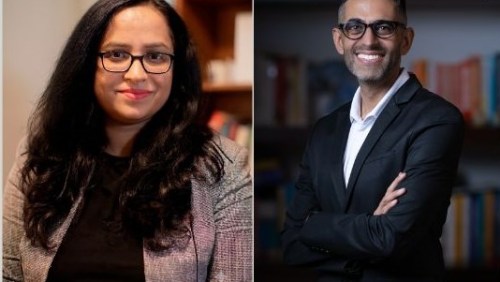
‘Building an Elephant, Not a Unicorn’: Dr. Somdutta Singh, Founder & CEO of Assiduus
“We’ve all seen the massive impact anelephant has on a jungle. I’m building anelephant, something built to last, withfoundations that don’t shake,” says Dr Somdutta Singh.

.
You're reading Entrepreneur India, an international franchise of Entrepreneur Media.
In an era of hustle culture, we are conditioned to visualize a “Daring CEO” or a founder
as a protagonist who is hyper-aggressive, working round-the-clock, and chasing growth at all costs.
Then you sit down with Dr Somdutta Singh, founder and CEO of Assiduus.
Singh stands out in today’s high-octane world by steering Assiduus with a financial discipline wherein sustainable long-term growth and profitability are prioritised over chasing the valuation hype or a ‘unicorn’ label. Her leadership focus remains on building a resilient foundation which is driven by employee wellbeing, individual empowerment, and deep-rooted accountability.
Set up in 2018, Assiduus has emerged as a leading AI-powered cross-border e-commerce middleware platform. It currently operates in 20 countries with integrations across 18+ commerce channels. Unilever, Red Bull, Dabur, and Himalaya are just some of the companies that Assiduus works with. It recently raised USD 25 million in a Pre-Series B funding round.
Assiduus’ journey reflects Singh’s own path, which is driven by a series of bold decisions.
Act I: Dare to Bet on Self
If you look back, it all began with her personal investment of USD 3 million into building the technology and innovation behind Assiduus before raising institutional funding—one of her first daring acts.
“At that point, there were no guarantees. I didn’t know whether the platform would scale, whether the market would embrace the model, or whether the investment would ever generate a return. But I believed that if I expected others to believe in my vision, I had to
demonstrate that conviction first,” Singh tells Entrepreneur India.
“As both an entrepreneur and an investor, I have always believed that founders should be willing to take the first and biggest risk themselves. Build first. Test first. Prove the hypothesis
first. Only then should you ask others to join the journey. It is easy to raise capital on a compelling story; it is far more meaningful to risk your own capital in pursuit of a conviction,” she adds.
For her, entrepreneurship has never been about transferring risk to investors. It has been about absorbing that risk before asking anyone else to come along.
“When founders have genuine skin in the game, it changes the relationship with investors, employees and customers. They know you are building for the long term, making decisions with discipline, and treating every dollar as if it were your own—because it is. That philosophy continues to guide me today. Capital is a responsibility before it is an advantage. I have always believed that the strongest signal a founder can send is not the valuation they raise at, but the conviction they demonstrate by backing their own vision first.”
Act II: Dare to be Different
Building a tech-enabled middleware for digital distribution and supply chain management may appear non-glamorous to many. Back in 2018, e-commerce was all the rage in an increasingly connected digital world.
“The most defining decision was choosing to build infrastructure instead of another e-commerce business,” Singh says. “When we started Assiduus, everyone believed the opportunity was to become another seller or aggregator. We took a very different path. We believed the future belonged to the company that enabled brands to sell globally rather
than competing with them. That meant investing years into building technology, data capabilities and supply-chain infrastructure before seeing meaningful returns. It was a far slower and harder journey, but it created a business that became deeply embedded in our
customers’ operations instead of merely becoming another channel partner,” she adds.
Her next big bet was the unwavering focus on profitability. “There were opportunities to raise capital at significantly higher valuations, but many of those came with expectations
that would have pushed us towards unsustainable expansion. We chose value creation over valuation creation. That discipline gave us resilience through multiple market cycles and allowed us to retain strategic control of the company while continuing to invest in long-term innovation,” she adds.
Act III: Dare to Brave the Process
Singh recalls that her most unconventional decision was refusing to become dependent on any one marketplace. As marketplaces became larger and more influential, many businesses built themselves around a single ecosystem.
“We believed that brands needed independence. We built a channel agnostic platform that could help brands operate seamlessly across marketplaces, quick commerce, D2C, retail and international markets. That philosophy has become even more relevant today as
brands seek greater ownership of their customer relationships, data and global expansion,” she says.
Looking back, Singh reflects, none of these decisions were anywhere close to being safe bets. Building something tangible requires time and patience. Processes and outcomes may seem slower, more difficult, and occasionally unpopular.
“But every one of them was guided by a single question: ‘Will this decision still make sense ten years from now?’ That long-term thinking has fundamentally shaped who we are today,” she notes.

Act IV: Dare to Detach
Before the calmer and more philosophical version of Singh we spoke with, she was deeply involved in every process. She used to believe leadership meant having all the answers, but this changed over time.
“I’ve always believed that courage in leadership is less about taking reckless risks and more about making unpopular decisions before they become obvious. One of the biggest transitions in my own journey was learning to evolve from being a founder into becoming a CEO. Many founders build companies around themselves. I consciously worked to build
systems, culture and leadership that could scale beyond me. That meant hiring people smarter than me, empowering leaders to make decisions independently, and building an organisation that was institutional rather than personalitydriven,” she explains.
She proudly notes that Assiduus maintains an attrition rate of less than 1%.
“Looking back, evolution happened in three very different stages. The first was Earning Trust. We were asking global brands to believe in a young ambitious company. Every negotiation was about proving we could deliver. Credibility had to be earned, one partnership at a time. The second was Learning to Scale. I realised the business could no longer depend on founder instincts alone. It needed strong systems, clear governance, and leaders who could make decisions with confidence. That is when institutional thinking became just as
important as an entrepreneurial instinct. My role gradually shifted from solving every problem to enabling others to solve them. Today we are in the third phase, Platform Leadership. Most of our conversations now go beyond the immediate deal and focus on the long-term partnerships. We are creating a platform where brands, marketplaces, logistics partners, and technology partners can all win together,” she explains.
Act V: Dare To Grow
Singh’s Assiduus is now entering a new phase of growth driven by a three-pronged approach:
“The first is Predictive Commerce. One of the biggest challenges in ecommerce is that many decisions are still made after demand has already shifted. Our AI models help brands anticipate demand by analysing factors such as seasonality, promotions, geography, marketplace behaviour, and consumer trends, allowing them to make better decisions before inventory is deployed.
The second is Pricing Intelligence. Cross-border pricing changes constantly with exchange rates, logistics costs, competitor pricing and marketplace fees, so we are building systems that recommend the right price while protecting both profitability and brand positioning.
The third is Working Capital Optimisation. Inventory is one of the biggest hidden costs for consumer brands, and our AI model helps decide exactly what stock should sit in which market, so brands carry less excess inventory while still keeping products available. That is already showing up in the results.”
Is Assiduus going to be the next unicorn? A better question is, is it the next elephant?
Singh has a great analogy for this: “I’m building an elephant, and I’m not building a unicorn… People haven’t seen unicorns. You and I have not grown up seeing any unicorn. They’re fallacies, which means it doesn’t exist… But you and I have seen an elephant. We have seen the enormous impact that an elephant has in a jungle. And I’m building an elephant. I’m building something that’s going to stay strong, where the valuation will not diminish … The value will continue to grow because of clients and what we have built in terms of our infrastructure, technology, and the middleware play.”
Act VI: Dare to Diversify
Through Karma Holdings, her family office, Singh is now wearing an investor’s hat to help empower new talent. Her approach to investment is heavily inspired by her own journey and beliefs.
For her, attributes like resilience and intellectual honesty are far more important than mere financial metrics.
“I invest in founders long before I invest in companies. Markets evolve, products change, and technology keeps advancing. What stays constant is a founder’s ability to learn, adapt, and reinvent themselves. The first quality I look for is Resilience. Building a company is rarely a straight path, and the founders who stay focused through uncertainty are often the ones who build enduring businesses. The second is Intellectual Honesty. I look for founders who are willing to change their mind when the data tells a different story. Strong conviction is important, but so is the ability to challenge your own assumptions. The third is Coachability. The founders who remain curious and continue learning usually outperform those who believe they already have all the answers,” she says.
Ultimately, Singh’s conviction shows that success is not defined by the fleeting hype of unicorns, but by the enduring strength of an elephant. By prioritising institutional resilience and long-term focus, Singh and the team are building a legacy that is built to last.
In an era of hustle culture, we are conditioned to visualize a “Daring CEO” or a founder
as a protagonist who is hyper-aggressive, working round-the-clock, and chasing growth at all costs.
Then you sit down with Dr Somdutta Singh, founder and CEO of Assiduus.

Entrepreneur Staff • Editor
Entrepreneur Staff
For more than 30 years, Entrepreneur has set the course for success for millions of... Read more